

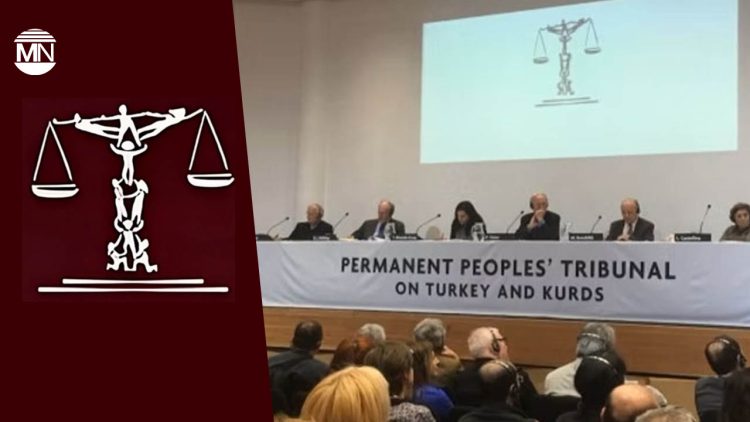
The Rojava People’s Tribunal has opened in Brussels, placing Turkey’s actions in North and East Syria under international scrutiny. The tribunal, held at Université libre de Bruxelles (ULB), has brought together human rights activists, legal experts, and survivors of Turkey’s military operations to present evidence of ethnic cleansing, targeted attacks on civilians, and economic exploitation.
Despite being invited to defend itself, the Turkish government refused to attend, resulting in an in-absentia hearing.
The tribunal commenced with a speech by Gerrit Loots, who emphasised the importance of the proceedings:
“We are here for this important tribunal, and the hearings will continue for two days. With the support of Université libre de Bruxelles, we stand for the protection of human rights and the defence of Rojava. Rojava is a place where women’s liberation and democracy are being built, and we will defend it.”
Legal experts Ceren Uysal and Jan Fermon presented the tribunal’s indictment, highlighting Turkey’s systematic violations of international law.
Uysal stated:
"Turkey is conducting ethnic cleansing in the region, which constitutes a crime against humanity. It continues to violate the very conventions it has signed, targeting both civilians and essential infrastructure in deliberate war crimes."
Fermon underscored Turkey’s use of water supply control as a form of collective punishment:
"Turkey is seizing control of water networks, endangering public health, and forcing local populations to leave. This is not just a humanitarian issue; it is a calculated strategy to reshape the region demographically."
Fermon pointed to documented cases of economic exploitation:
The unbiased documents confirm Turkish forces have looted Afrin’s (Efrîn) olive oil industry, selling Kurdish products under Turkish branding. Factory machinery from Afrin has been stolen and transported to Turkey in an act of economic pillage. Street names in Afrin have been changed to Turkish and Arabic, erasing Kurdish heritage. Religious manipulation is being used to expand Turkey’s influence in the region.
Uysal presented evidence of ongoing Turkish airstrikes, including attacks on civilians defending the Tishreen (Tişrîn) Dam—a key water and energy source in North and East Syria. She named Turkish President Erdoğan and Defence Minister Yaşar Güler as responsible parties and called for an arms embargo on Turkey.
Lawyer Efstathios C. Efstathiou provided a detailed report on Turkey’s crimes in Afrin, describing in details:
*The mass displacement of Kurds
*Extrajudicial killings of civilians
*Forced demographic engineering
Activist Öz Karahan compared Turkey’s occupation of Afrin (Efrîn) to its historical policies in Cyprus, where similar mass displacement and property confiscation took place.
Following panel discussions and testimonies, the tribunal took a short recess of noon before further witness hearings. The next sessions will focus on Turkey’s use of banned weapons, attacks on women and children, and ongoing military aggression in North and East Syria.


