

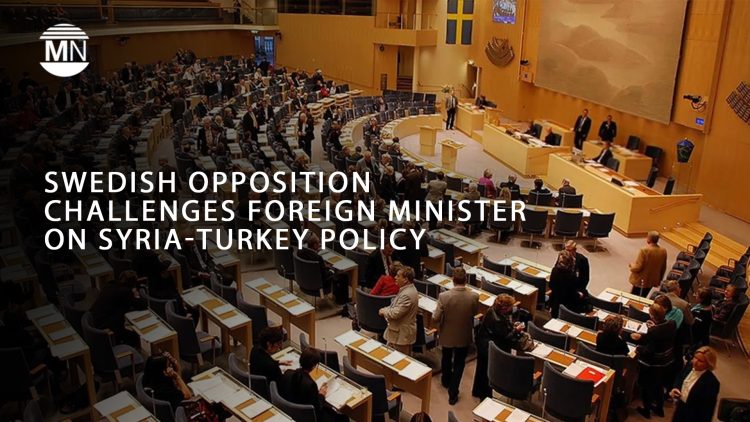
A heated debate in the Swedish parliament has drawn attention to Sweden’s approach towards Syria, particularly its stance on Kurdish autonomy, Turkish aggression, and jihadism in the region.
At a session in Sweden’s parliament the Rikstag on 23 January, members of the opposition questioned Foreign Minister Maria Malmer Stenergard about the country’s current policy on Syria. Opposition parties also criticised the government for compromising its values during negotiations over NATO membership, and urged a return to Sweden’s earlier pro-Kurdish position.
This public debate was initiated following a formal interpellation (interruption) by Social Democrat MP Ola Möller, who raised serious concerns about Turkey’s involvement in Syria and its targeting of Kurdish groups. In his parliamentary question, Möller called on Malmer Stenergard to clarify what measures the government intends to take to ensure Turkey respects international humanitarian law and to safeguard the rights of Kurds and other minorities in the region.
The discussion followed Malmer Stenergard’s visit to Turkey on 21 January, where she met with Turkish Foreign Minister Hakan Fidan. In the meeting, Malmer Stenergard highlighted the importance of the bilateral security pact between Sweden and Turkey, stressing the need for cooperation in combating international crimes, terrorism and organised crime, while addressing broader regional stability concerns.
Sweden’s foreign policy has evolved significantly since the Social Democratic government’s tenure before the Russia-Ukraine war. Previously, under then-Foreign Minister Ann Linde, Sweden was a vocal critic of Turkish policies and a strong supporter of the Kurds. However, this position shifted during Sweden’s NATO accession discussions, with pivotal dates including the trilateral memorandum signed on 28 June 2022 at the Madrid NATO Summit and further negotiations on 21 March 2023.
Möller accused the government of “falling in line with Turkey’s agenda” and expressed concerns over Ankara’s aggressive policies in Syria. He said, “Turkey occupies 15% of Syria, supports jihadist groups, and targets Kurdish forces who were instrumental in defeating ISIS. But Sweden remains silent.”
In response, Malmer Stenergard reaffirmed Sweden’s commitment to supporting an inclusive and democratic transition in Syria, respecting human rights and maintaining territorial integrity.
“Syria’s transition must involve all groups, including women and minorities such as the Kurds,” she said. The minister highlighted Sweden’s humanitarian aid, which amounted to nearly SEK 250 million [$22.7 million USD] in 2024, and reiterated that discussions with Turkey included calls for de-escalation and adherence to international law.
However, critics argue that Sweden’s NATO negotiations have diluted its once-strong advocacy for Kurdish rights. Möller pressed further:
“What specific demands were made to Turkey about its bombing campaigns in Rojava [North and East Syria]? How does Sweden intend to address Turkey’s support for jihadist groups?”
Veteran Kurdish-Swedish Social Democrat MP Kadir Kasirga called on Sweden to renew its support for the Kurdish cause. In an earlier article, covered by Medya News, Kasirga highlighted Sweden’s historical role as a human rights defender and urged the country to stand with the “freedom heroes” of Rojava.
“Sweden must act through the EU, NATO and the UN to put pressure on Turkey and protect Rojava,” Kasirga said. He emphasised the Kurdish commitment to an “inclusive social model based on equality and democracy”, contrasting it with Turkey’s authoritarian policies. He also proposed urgent measures such as a no-fly zone to shield Kurdish regions from Turkish airstrikes.
Håkan Svenneling, a Swedish MP from the Left Party and a long-time advocate for Kurdish rights, joined the criticism. Svenneling, who has previously called on the Swedish government to address the incommunicado detention in a Turkish prison of Kurdish leader Abdullah Öcalan, expressed concerns over Sweden’s closer ties with Turkey.
“Turkey’s aggression in northern Syria undermines efforts to stabilise the region and emboldens jihadist groups,” Svenneling said. He urged the government to re-engage with Kurdish political organisations like Syria’s Democratic Union Party (PYD) and the People’s Protection Units (YPG), and criticised Sweden’s reluctance to challenge Turkey’s human rights record.
Svenneling, who has repeatedly stressed the importance of supporting Kurdish-led governance in Rojava, said:
“The Kurdish self-administration has been the most effective force against ISIS and a beacon of democracy in Syria. Sweden must take a principled stance to support them.”
He also noted that Sweden should take a principled stand for Rojava’s democracy and human rights, pointing out that the government is under pressure to change its stance to be more in line with Sweden’s historical human rights policy.
The debate also touched on the risk of an ISIS resurgence. Green Party MP Jacob Risberg stressed the importance of supporting the Kurdish-led administration in North and East Syria, which currently has thousands of ISIS fighters in detention. “Turkey’s attacks on Kurdish regions destabilise efforts to contain jihadism,” he warned.
Under Ann Linde’s tenure, Sweden strongly criticised Turkey’s military incursions into Syria and championed Kurdish-led governance models in Rojava. However, concessions made during NATO negotiations have raised questions about Sweden’s commitment to these principles.
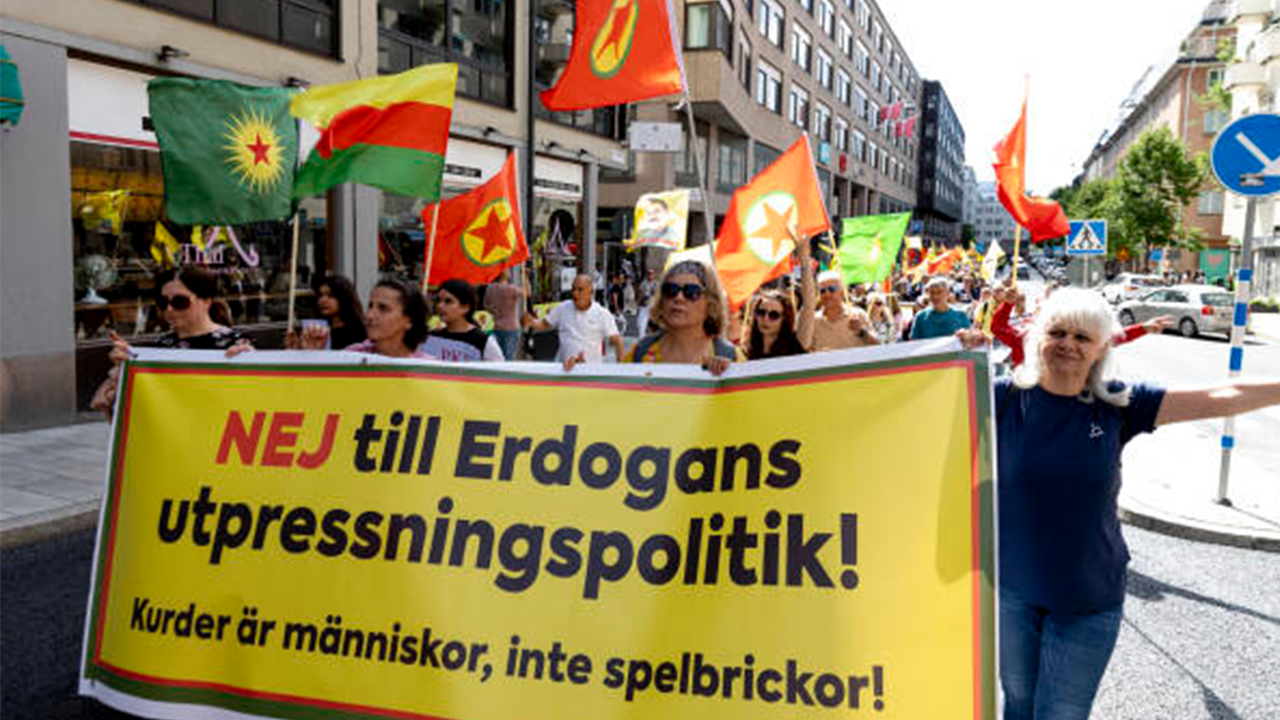
“Protesters in Stockholm holding Kurdish flags and banners supporting Rojava. Sweden must take the right side of history by supporting Kurdish democracy and freedom” – Kadir Kasirga, Social Democrat MP
As the Syrian conflict enters a new phase following the fall of the Assad regime, Sweden faces mounting pressure to clarify its stance. Opposition parties are urging the government to use its NATO membership and EU influence to hold Turkey accountable while advocating for a democratic and inclusive future for Syria.


