

A new report published in January 2025 by the International Institute for Strategic Studies (IISS) analyses the intricate dynamics of the Eastern Mediterranean, a region spanning Cyprus, Egypt, Greece, Israel, Lebanon, Libya, Syria, and Turkey. The study also focuses on Turkey’s military interventions in Syria and Iraq, which have intensified regional tensions. These actions, aimed at targeting Kurdish groups deemed a threat by Ankara, have drawn widespread criticism and added to the complexity of conflicts in the region.
Turkey’s assertive actions in Syria, including its efforts to prevent a Kurdish autonomous region, and its operations in Iraq to counter Kurdish militias, highlight a pattern of aggressive regional policy. These interventions, combining direct military action with proxy support, have achieved limited goals but deepened mistrust among neighbouring states. The report underscores the profound impact of these actions on regional stability and security dynamics.
The study raises critical questions: How likely are inter-state conflicts? Can energy discoveries foster regional cooperation or deepen divisions? What role will external actors play in shaping the region’s future? As nations vie for influence and control, these uncertainties underscore the fragility of peace in the region.
Turkey’s imperialist maritime claims and the “Blue Homeland” doctrine have exacerbated long-standing tensions with Greece and Cyprus. Historical grievances over maritime boundaries and Turkey’s occupation of Northern Cyprus since 1974 remain key points of contention. While international frameworks such as the United Nations Convention on the Law of the Sea (UNCLOS) offer pathways for resolution, entrenched geopolitical rivalries have stymied meaningful progress. The report warns that escalating brinkmanship could destabilise an already fragile situation.
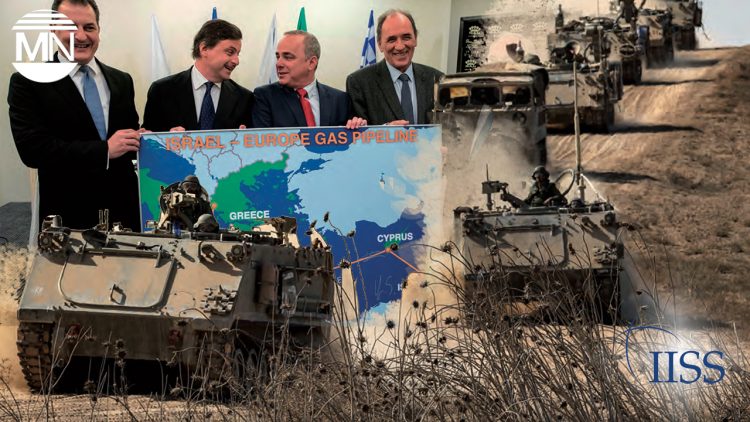
The discovery of significant natural gas reserves has further complicated the geopolitical chessboard. Countries like Israel, Egypt, Turkey, and Greece are vying for dominance over lucrative energy corridors linking Asia and Europe through the Eastern Mediterranean. The EastMed Pipeline project, among others, has become a focal point of contention, with nations seeking to position themselves as energy hubs. However, mistrust and political volatility have hindered efforts at regional cooperation. The report notes that energy remains a potential driver of both collaboration and conflict, depending on how states navigate their ambitions.
Military dynamics add another layer of complexity. While Turkey’s interventions in Syria and Iraq are central to its strategy, Greece, Israel, Egypt, and Cyprus have bolstered their defence capabilities, engaging in joint exercises and modernisation efforts. Despite these developments, the report highlights that defence cooperation in the region remains inconsistent and plagued by misaligned objectives, limiting its effectiveness as a stabilising force.
External actors such as the United States, Russia, and China also play pivotal roles in the region’s geopolitical landscape. While the US has scaled back its physical presence, crises like the Russia-Ukraine war and Israel’s genocide in Gaza have necessitated renewed engagement. Russia’s military footprint in Syria and China’s investments through its Belt and Road Initiative underscore their growing influence. However, the report suggests that these external powers are more focused on leveraging the region to advance their broader strategic goals than resolving its conflicts.
Migration and terrorism remain persistent challenges stemming from the region’s instability. While migration flows to Europe have decreased since 2015, the socio-economic collapse in Lebanon, ongoing conflicts in Syria and Libya, and renewed violence in the Palestinian Territories continue to drive displacement. The report highlights the potential for these factors to exacerbate security risks, both within the region and for neighbouring Europe.
Economic necessity has moderated some of Turkey’s aggressive policies, but President Recep Tayyip Erdoğan’s ambitions to secure a legacy comparable to Mustafa Kemal Atatürk’s continue to shape his approach. The report concludes that despite the region’s energy potential and strategic importance, no single player or coalition appears capable of dominating the Eastern Mediterranean. This ensures that it will remain a theatre of constant competition and realignment in the foreseeable future.


