

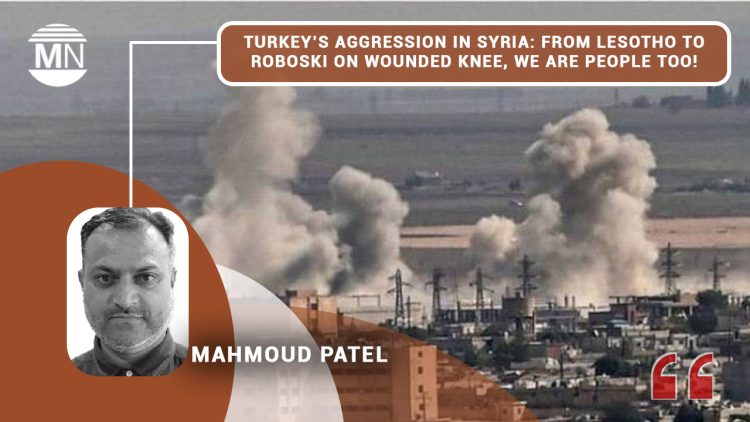
Mahmoud Patel
Turkey’s aggression and massacres against Kurds in Syria remain a grim reality on the daily agenda. Turkish-backed mercenaries and proxies have been attacking the people with every weapon at their disposal, including sophisticated drones. They do not hesitate to strike caravans of civilians or residential homes. In just the last three days, a total of eight civilians have been killed brutally, three of them children. This article offers a research-based perspective on the parallels between massacres committed in South Africa during apartheid and Turkey’s actions in Kurdistan, including the Roboski massacre. By doing so, it sheds light on the structural and political alignments that enable such inhuman acts of violence.
The Apartheid Regime and “Operation Blanket”
The parallels of draconian, tyrannical states perpetrating crimes against humanity are stark. The apartheid-killing machinery knew no borders, shamelessly violating international law by undermining the sovereignty of other states, much like the Turkish state and its NATO counterparts, in particular the United States of America (USA). On 9 December 1982, the then South African Defence Force (SADF) soldiers and its officers crossed the South African border into Maseru, Lesotho. They carried out one of the bloodiest cross-border raids in the history of apartheid South Africa. The raid was dubbed by the apartheid SADF as “Operation Blanket”. Homes and settlements where members of the African National Congress (ANC) and its military wing, Umkhonto weSizwe (MK) resided were raided, killing a total of 42 people, comprising 30 South Africans and 12 Basotho. Among the dead were women and children, the youngest was four-year-old Teboho Jafeta. Four years of age! The SADF cross-border raid was described by then Lesotho Foreign Minister Charles Molapo as a “dastardly, cowardly and barbaric act”.
On 23 December 1982 Oliver Reginald Tambo, at the time President of the ANC, attended the mass funeral led by King Moshoeshoe II. In his message at the funeral Oliver Tambo said, “These events have united us because, your Majesty, your people responded to this massacre with the courage that is part of their tradition and part of their history. The murderous crime has lifted this nation from its geographic circumstances and planted them in the hearts of the nations of the world, winning it the support and solidarity of mankind”. Three years later, on 19 December 1985 another ghastly cross-border raid was carried out by the apartheid SADF in Maseru – where six South African political refugees, most of them members of the ANC and MK, and three Lesotho nationals were killed. Phyllis Naidoo documents the most traumatic experiences for the small mountain kingdom of Lesotho. In it, she writes, “Time has obliterated 30 comrades and 12 Basotho from our collective memory… the last supper of my story was had by all, 42 in number, in and around Maseru, Lesotho, without any notice of death, a trial, premonition or otherwise of death that was to follow…”. She continues, “Scores of South Africans – whom the South African government referred to as well-trained terrorists – and Basotho were mercilessly killed in this barbarous act of aggression. Homes were destroyed, houses gutted by fire and bombed from the air in this cold-blooded massacre”.
The Roboski massacre: Crimes against a Stateless Nation
On 28 December 2011, a US Predator drone flying over the mountains along the Iraq – Turkey border detected a surge in wireless communication. US officials alerted Turkish military officials about the crossing of a suspected group of Kurdistan Workers’ Party (PKK) into Turkish territory. Within a matter of hours, Turkish jets and artillery responded by bombing the group. The bombardment lasted 45 minutes. The victims of the bombing – 34 civilian adult males and children, along with 50 mules – were massacred. Nineteen of the massacred were children, with the youngest 12 years old!
The Roboski massacre will go down in history as one of the most atrocious crimes by the Turkish state against its Kurdish population. Selahattin Demirtaş, who was then the leader of the Peace and Democracy Party (BDP), issued a statement correctly identifying the incident as a massacre of civilians, emphasising that among the victims, the eldest was only 20 years old. Despite this tragic loss of innocent lives, Demirtaş urged the Kurdish community to respond through peaceful and democratic means in the face of this grave injustice. The mass funeral was attended by thousands with many who thereafter listened to the stories of the mothers, fathers and siblings to not only share the pain of the families of Roboski but to challenge the Turkish State’s refusal to recognise the massacre of human beings while bearing witness to a Stateless Nation bleeding through borders of existing colonial states. Gültan Kışanak, a senior BDP leader at the time (2011), was correct in calling Roboski a crime against humanity, and rightly resolute in the Turkish Parliament on 3 January 2012 stating that “…we will never let this be forgotten”.
Colonialism and its ongoing injustices
On 29 December 1890, more than 300 Lakota men, women and children were massacred at Wounded Knee. The trinity of injustices – racism, capitalism, and patriarchy – long festering progenitors beneath the surface of Capitalist societies in the USA, Turkey and apartheid South Africa are out in the open, and placed on centre stage at Lesotho (Operation Blanket), Roboski and Wounded Knee, which force us to confront another foundational injustice in contemporary politics, colonialism.
It is contentious, even offensive, for many in the establishment and outside, to suggest that colonialism endures in the present. In the US and Turkish popular imagination, despite their State and Arms Manufacturers being complicit in the massacres at Roboski and Wounded Knee and the USA being supportive of the apartheid State and its SADF, colonialism for them ended for the USA in particular either when the 13 colonies declared independence from Britain in 1776, or when the frontier closed and open warfare against indigenous nations ceased following the Wounded Knee massacre. Colonialism, according to these narratives, is Ancient History.
However, ongoing colonialism is the central injustice that the oppressed in the majority world (so-called third world) resist and seek to change, despite the massacres in Lesotho, Roboski and Wounded Knee. If international solidarity and solidarity with the oppressed is to be meaningful and striving for a humane world it must take the trinity’s injustices and colonialism seriously.
Colonialism is rooted in the theft of land from indigenous people. It endures in the ongoing disavowal of indigenous sovereignty. Indigenous presence must be contained, removed, and then forgotten so that the USA and Turkish state can continue to live on, and profit from, lands taken from indigenous people. Who owns the guns and bombs? Is it not the products of the holy trinity in the USA, Turkey, Apartheid South Africa enabled by colonialism?
Wiping out any trace of indigenous peoples allows the settlers to push forward without any moral reckoning, and without a thought or word about recognition, reparations, or repatriation. It enables the proliferation of myths, dreams, and even utopias predicated on fantasies of a free land without a prior and rightful guardian. The Kurds are Stateless for over a century, while the native peoples in the USA are in reserves. Post-Apartheid South Africa grapples to realise an egalitarian society that is still skewed to the previous beneficiaries of Apartheid. It explains why the indigenous peoples are subject to State action against their will before their freedoms, basic infrastructure like homes, schools and hospitals are built. It explains how years of unprecedented protests, legal action and commemorations have yet to yield Justice. It is impossible to describe the totality of this picture, of crimes against humanity, theft of land, poverty, oppression, surveillance and policing, as anything other than colonialism.
This explosive truth can lead even the most radical thinkers to fatalism. Confined to the past, the colonisation of indigenous people appears inevitable if regrettable. Brought into the present, colonialism seems irreversible. But despite all the forces brought crashing down upon indigenous people, we are still here. They came for our land. They came for our resources. They came for our children. They came to destroy us, our communities, our territories, our families, our bodies, our languages, our cultures, our knowledge, our love. But yet we remain. We stand for something that is undeniably right, our Humanity. As long as we are here on the land of our ancestors, the men who put profit before the planet and people will not and cannot win. As long as we are here, colonialism, apartheid and its massacres have failed for we are Le rona re batho (we are also people) from Lesotho to Roboski on Wounded Knee!
Mahmoud Patel, legal scholar, academic and human rights activist is the Chairperson of the Kurdish Human Rights Action Group in South Africa.


