

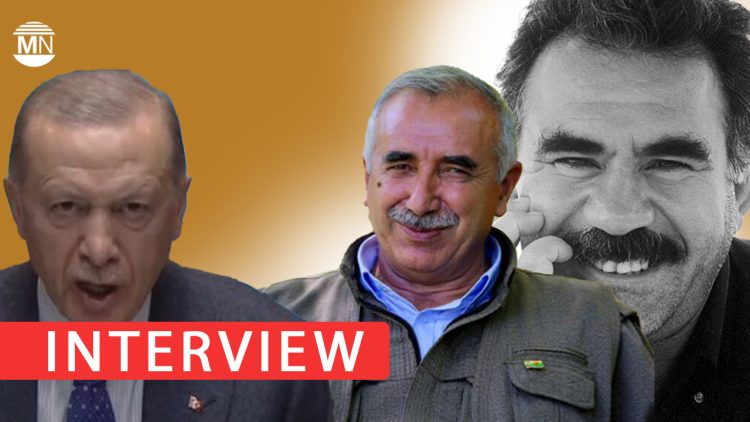
Murat Karayılan, a senior figure in the Kurdistan Workers’ Party (PKK) emphasised the critical importance of imprisoned Kurdish leader Abdullah Öcalan’s recent efforts to offer a peaceful resolution to the Kurdish issue. Describing Öcalan’s proposals as “historic and transformative,” Karayılan said that they provide a framework for Turkish-Kurdish reconciliation and benefit all people in the region. He noted that Öcalan’s meeting with the Peoples’ Equality and Democracy (DEM) party delegation marked a significant moment, as it broke a prolonged period of isolation and conveyed essential messages to political actors in Turkey.
A Historic Initiative from Öcalan: The Path to Peace
“Önder Apo’s [Abdullah Öcalan, Önder Apo is an affectionate honourific term] proposals are not ordinary; they are historic. They offer the most comprehensive and viable solution for the Kurdish question and the broader region,” said Karayılan. He praised Öcalan’s consistent efforts over the decades, adding, “Önder Apo has always seized every opportunity to advocate for a democratic and political resolution. His recent call to all political actors to “act without narrow, short-term calculations’ demonstrates his dedication to peace.”
However, Karayılan expressed disappointment over the Turkish government’s lack of meaningful engagement. “While state representatives have reportedly met with Önder Apo, there is no visible commitment to his proposals. Instead, the government continues to perpetuate a rhetoric of threats and destruction. This is a grave mistake that ignores a historic opportunity,” he stated.
Erdoğan’s Contradictions: Peace or War?
Karayılan criticised Turkish President Recep Tayyip Erdoğan for his contradictory approach to the Kurdish issue. While Erdoğan’s government has engaged in dialogue with Öcalan, the president’s public statements and actions contradict the essence of reconciliation. Referring to Erdoğan’s recent remarks, where he described his government’s approach as an “iron fist in a velvet glove,” Karayılan said this exposes the administration’s dual strategy of public diplomacy and covert aggression.
“Erdoğan talks about burying weapons or those who carry them, yet his government simultaneously seeks Önder Apo’s guidance. This duality is neither sincere nor sustainable,” Karayılan argued. He accused Erdoğan of using psychological warfare to mislead the public and discredit the Kurdish movement.
Drawing from Erdoğan’s rhetoric, Karayılan added, “His statements reflect an unwillingness to acknowledge Kurdish political aspirations. If Erdoğan truly believed in peace, his language would reflect dialogue, not threats. His reliance on military aggression shows his inability to grasp the shifting dynamics of the region.”
The Rojava Resistance: A Model Under Attack
Addressing the ongoing conflict in Rojava [the Autonomous Administration of North and East Syria-AANES] , Karayılan highlighted the region’s significance as a revolutionary model of governance rooted in women’s liberation, ecology, and pluralism. He condemned Turkey’s persistent aggression against Rojava, framing it as a calculated effort to dismantle a democratic system that challenges authoritarian norms. “Rojava represents a beacon of hope, not only for Kurds but for all oppressed peoples. Turkey’s obsession with its destruction stems from fear—fear of a successful model inspiring change beyond its borders,” he remarked.
Karayılan rejected claims that the PKK’s presence in Rojava poses a problem, describing such narratives as part of Turkey’s “special warfare tactics.” He clarified, “The PKK contributed to Rojava’s defence and sacrificed greatly. However, Rojava is a collective project involving Kurds, Arabs, Assyrians, and other communities. Turkey’s framing of Rojava as a PKK entity is a deliberate strategy to delegitimise its achievements.”
He also expressed confidence in Rojava’s ability to resist further aggression. “The leadership in Rojava has learned from past experiences. They have developed advanced defence strategies, and another Afrin or Serêkaniyê scenario is unlikely. Turkey’s threats are designed to intimidate, but they underestimate the resilience of the people of Rojava,” Karayılan asserted.
The PKK’s Resilience in the Face of Aggression
Karayılan dismissed Turkish government claims that the PKK is weakening, calling them baseless propaganda. He pointed to the PKK’s continued capacity to counter advanced military tactics and remain a pivotal actor in Middle Eastern politics. “If we were weak, as they claim, they would not seek Önder Apo’s guidance. Our resilience and influence are undeniable, and our capacity to adapt to modern warfare has been proven time and again,” he stated.
Citing the PKK’s ongoing military success, Karayılan explained, “For over four years, the Turkish military has failed to achieve its objectives in regions like Zap and Metîna, despite using NATO-grade weaponry and advanced technology. This is a testament to the PKK’s strategic depth and the courage of our fighters.” He also highlighted the PKK’s achievements in countering drone warfare, noting, “Our fighters have developed tactics to neutralise their drones, disproving Turkey’s narrative of dominance.”
A Call for Genuine Dialogue and Trust
Karayılan stressed that trust-building measures are essential for any meaningful resolution to the Kurdish question. He pointed to the ongoing military aggression, Öcalan’s isolation, and the arrests of Kurdish politicians as evidence of the Turkish government’s insincerity. “The Kurdish people have a fundamental trust issue with the Turkish state. Building trust requires not just words but actions—lifting the isolation on Önder Apo, ending military operations, and ceasing the criminalisation of Kurdish identity,” he argued.
He further criticised the use of incendiary language by Turkish media, stating, “The toxic rhetoric against Önder Apo and the Kurdish movement only deepens divisions. If there is a genuine commitment to peace, the government must abandon this war-driven narrative.”
The Future of the Kurdish Struggle
Karayılan concluded by emphasising the PKK’s readiness to support a peaceful resolution while remaining steadfast in its commitment to self-defence. “We are a movement rooted in honour and sacrifice. While we are prepared to engage in a peace process aligned with Önder Apo’s vision, we will never capitulate to threats,” he affirmed.
Highlighting the broader regional dynamics, he added, “The Kurdish people are an essential part of the Middle East’s reconfiguration. Any attempt to exclude us is doomed to fail. The PKK will continue to be a decisive force in shaping the region’s future.”


