

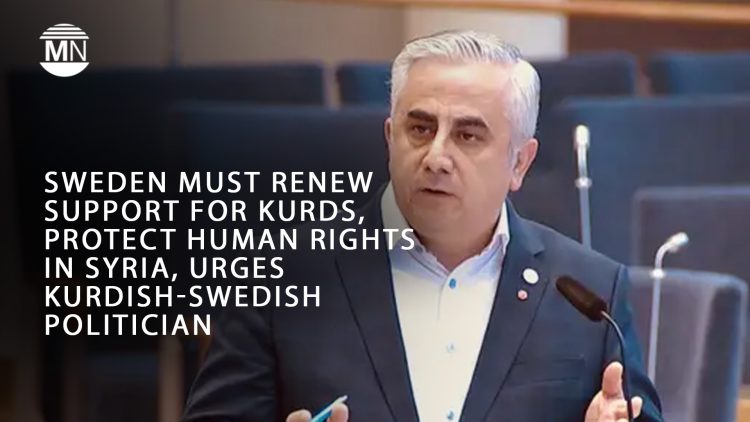
Veteran Swedish politician Kadir Kasirga, a member of the Riksdag, has called on Sweden to renew its support for the Kurdish cause. In a column published in Expressen, Kasirga highlighted Sweden’s historical role as a human rights defender and urged the country to stand with the “freedom heroes” of Rojava (North and East Syria) and other Kurdish regions.
“Will Sweden dare to stand up for the freedom heroes in Rojava who defeated ISIS?” Kasirga asked. He highlighted the Kurdish commitment to an “inclusive social model based on equality and democracy,” which he contrasted with the authoritarianism of the new Hay’at Tahrir al-Sham (HTS) leadership in Damascus and the Turkish government.
“The Kurdish social model is an antithesis to the authoritarian and religiously conservative direction that both HTS and Turkish President Erdoğan advocate.”
Kasirga urged Sweden, a new NATO member state, to protect religious and ethnic minorities in post-Assad Syria by supporting Kurds and intervening to halt Turkey’s cross-border military attacks aimed at dismantling Kurdish autonomy.
Having served as the second mayor of Stockholm Metropolitan City in 2019 to 2022, Kasirga is a prominent figure in Swedish politics with ties to the Social Democratic Party (SDP). During the tenure of the SDP government, Sweden’s official stance was one of strong support for Rojava and the Autonomous Administration of North and East Syria (AANES). SDP’s Ann Linde, Sweden’s former Foreign Minister, and other officials engaged directly on several occasions with Kurdish leaders, including Ilham Ahmed, a prominent Syrian Kurdish politician.
However, this dynamic shifted dramatically in the context of Sweden’s bid for NATO membership, following the outbreak of the Russia-Ukraine war. Turkey leveraged its position as a NATO member to impose conditions on Sweden’s accession, including demands to clamp down on Kurdish activists within Sweden, end support for the AANES, and extradite individuals Turkey deems as threats. Facing Turkish vetoes and geopolitical pressures, Sweden made concessions, retracting its support for the Kurds at Turkish President Tayyip Erdoğan’s direct behest.
Kasirga and other Kurdish advocates are now pushing Sweden to reclaim its role as a defender of human rights, despite a political climate that has grown more hostile to the Kurds under the current conservative government, supported by the far-right Sweden Democrats.
“Sweden should act through the EU, NATO and the UN to put pressure on Turkey and protect Rojava.”
Kasirga also called for urgent international intervention to protect civilians and displaced persons under Turkish airstrikes in northern Syria. Given the escalation in December, he proposed Sweden should use its influence to impose a no-fly zone over the region to shield vulnerable populations from further harm.
“Erdoğan has shown time and time again that he would rather have an Islamist Syria as a neighbouring country than a democratic and autonomous Kurdish self-government. Through its attacks on Kurdish areas, Turkey has shown that it sees Rojava as a greater threat than Islamist fundamentalism.”
Kasirga’s argument highlights the tension between Sweden’s historical commitment to human rights and its conflicting obligations as a NATO member, shaped by compromises made during its NATO accession process. He emphasised that Sweden must “take the right side of history” to preserve its credibility, urging the country to reaffirm its support for the AANES in their fight for democracy and freedom while upholding its responsibilities to advocate for human rights and international law.


