

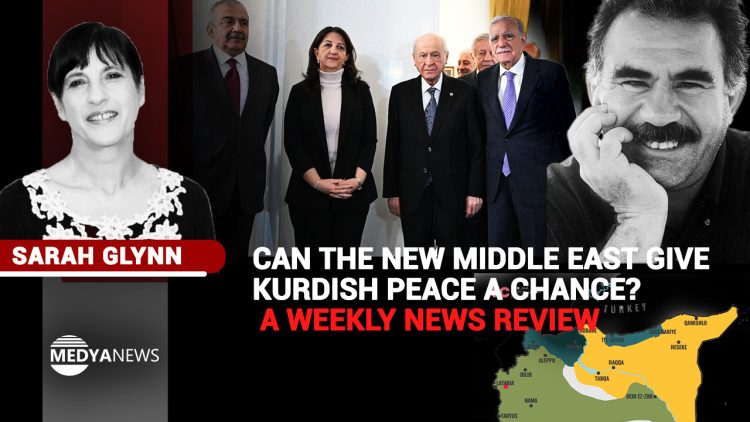
Sarah Glynn
Another week in which history is being made at breakneck speed, and the most significant events have taken place behind closed doors. Last Saturday, DEM Party MPs, Pervin Buldan and Sırrı Süreyya Önder, were finally permitted to visit Abdullah Öcalan in İmralı island prison and to discuss with him for three hours, raising hopes that talk of peace negotiations might become a reality. On Thursday, together with Ahmet Türk, a former MP and deposed Mayor of Mardin, Buldan and Önder met with Devlet Bahçeli, the leader of the Far-Right Nationalist Movement Party (MHP) who has spearheaded the government’s new line with respect to Öcalan. Next Monday they will meet with President Erdoğan’s Justice and Development Party (AKP) and other opposition parties. Meanwhile, last Monday, representatives of the Syrian Democratic Forces (SDF) – the defence forces of the Autonomous Administration of North and East Syria – held their first meeting with the new de facto leader of Syria, Ahmed al-Sharaa.
These are meetings we know about, but we can be sure that there were many other important discussions that were not made public. The latter will include discussions between the United States and Turkey with respect to the limits of Turkish aggression against the areas controlled by the Autonomous Administration. Turkey is continuing to attack the strategically important Qara Quzaq bridge and Tishreen Dam, where mercenary militias of Turkey’s Syrian National Army (SNA) are being aided by Turkish drones and supplied with Turkish military hardware. There is heavy fighting; however, Turkey has not launched another full-scale invasion. And the US-led collation is reported to be constructing a base in Kobanê, which Turkey had marked out as the next focus for their attacks.
Remaking the Middle East
This historical whirlwind is taking place within a wider storm. The remaking of the Middle East is a project of US imperialism – with Israel acting as their relentlessly brutal attack dog, and the United Kingdom and Europe providing practical assistance and diplomatic cover. That is not to say that other states and entities active in the region are not subjects in their own right, acting in their own interests, but their actions are constrained and impacted by the wider political picture. It also doesn’t mean that the United States is in control of the results of its policies and actions and that these will turn out as they intended. Many different players are interacting here, and the consequences are unpredictable. New possibilities open up and old ones close; and political actors have to be ready to change plans to benefit from changing circumstances and to exploit unexpected opportunities.
The weakening of Hezbollah and Syria’s Iran proxies by the United States and Israel opened the opportunity for Hayat Tahrir al-Sham (HTS) to push over Bashir al Assad’s fatally weakened government. Assad’s fall had long been the aim of the United States, and previously also of Turkey, but it seems that no one had predicted that Assad’s power would crumble so quickly and that HTS would be transformed into de-facto rulers of the greater part of Syria.
Turkey has been very quick to take advantage of the change of circumstances and consequent power vacuum, both to increase their influence in Syria as HTS’s main backer, and also to launch a second front against the Autonomous Administration of North and East Syria – of which more later.
A catalyst for a meeting
But Turkey also has other concerns about the possible outcomes of the Middle East’s political earthquake. They are worried that this might provide opportunities for greater Kurdish independence: that the United States and Israel might choose to reinforce their own dominance by breaking up and weakening existing states through supporting the creation of an independent Kurdistan. This would be no philanthropic act to benefit the Kurds, but a calculated move to eliminate potential challenges to US power, and could leave the Kurds dangerously isolated.
In the view of the Turkish Government, any form of Kurdish independence would be a disaster, and this background can provide an explanation for the Turkish Government’s tentative moves towards a possible peace process – the argument being that Kurds might be persuaded against pursuing such a risky path if they saw a possibility of achieving at least the cultural and linguistic freedoms that they have been demanding. Even so, it is not clear how serious the government is with regards to real change.
Saturday’s meeting with Buldan and Önder, and Öcalan’s earlier meeting with his nephew, Ömer, are hugely important, but Öcalan is still being deprived of even the minimum contact stipulated in law, and the Turkish state has only increased its anti-Kurdish attacks. If they want to win people’s trust, the Turkish government needs to change their behaviour to demonstrate that what is happening is a genuine process and not a temporary tactic or a trick to sow confusion.
A failed policy of aggression
The changing power balances, which were already concerning Turkey before the fall of Assad, appear to have provided a catalyst for the Öcalan meetings, but there are also more long-running reasons that could make the government question their current plan to attack and destroy the Kurds on all fronts. This plan, which was conceived in 2014, before Erdoğan ended and repudiated the last “peace process”, has failed to destroy Kurdish resistance. It hasn’t managed to dampen support for the Kurdish Freedom Movement, which was given a huge boost by the establishment of the Autonomous Administration in Syria. And Turkey’s unsatisfied obsession with destroying the Kurds is bleeding the country of vital resources.
Öcalan’s message
After last Saturday’s meeting with Öcalan, the DEM Party put out a short initial statement on Öcalan’s message to the public, which is designed to help make serious discussions a reality. His message is diplomatic and dignified, and no one reading it would guess that its author was a prisoner referring to his oppressors.
He stresses the central role of the Turkish parliament and the importance of bringing in all political groups, within and outwith parliament. This would help ensure a wide interest in making any negotiations genuine and in bringing them to a successful conclusion. It would make it more difficult for the government to hijack and destroy the process for their own short-term interests, as happened in the discussions that took place in 2013-15.
The phrase Turkish-Kurdish brotherhood has been much bandied about, but Öcalan reclaims ownership of it, restoring its true meaning as a real brotherhood of equals. He warns of the dangerous sectarian conflicts being orchestrated in the Middle East, and states that a peace process could benefit Turkey and also Turkish democracy (which is something that the current government has shown little interest in). And he emphasises his own will and ability to take the peace process forward.
Selling peace
Öcalan has been ready to talk to the government for years. If, this time, the government is indeed seriously looking to make peace, any agreement would have to be sold to a population that has been fed a diet of anti-Kurdish hate. The government approach to this is to attempt to focus that hate on the Kurdistan Workers’ Party, the PKK, as though the PKK were the spoilers of a beautiful relationship and somehow responsible for Kurdish repression, rather than a response to a repression that had already been going on for decades. Such an approach would be more than acceptable to the United States and Europe, who have no love for the PKK’s radical democracy and anti-capitalism. In an attempt to marginalise the PKK and also to sow confusion, a rumour was started that Öcalan had sent a message to the PKK and the PKK had rejected it. Amed Dicle stresses that this is not only untrue, but also unbelievable.
The end of the PKK could be sold as a government victory, but, from the perspective of Öcalan and PKK members, this would have to be accompanied by an end to the conditions that gave birth to the PKK in the first place. Government authorities would have to stop clamping down on expressions of Kurdish culture, and would have to demonstrate that the “fraternal” relationship between Turks and Kurds was not founded on bullying. As Öcalan’s message makes clear, there would need to be the possibility of progress towards real democracy. If the Kurdish movement is to be persuaded to move from armed conflict to political engagement, there needs to be a democratic system to engage with. At present, democracy seems very far from the government agenda. The social reintegration of Kurdish guerrilla fighters seems even further.
Peace would be widely welcomed in and of itself, as was demonstrated during the lull that accompanied the 2013-15 peace dialogues, and the Turkish economy is in sore need of a peace dividend.
The majority of politicians believe that a peace deal would be generally popular, and the more groups there are invested in a deal, the more likely it is to happen. The possibility of peace talks is supported by the main opposition Republican People’s Party (CHP); and the extreme nationalist MHP, Erdoğan’s coalition partners, have been put at the head of the current initiative. This just leaves their right-wing rivals in the İYİ Party to manufacture a role for themselves as home for the anti-Kurdish opposition.
The DEM Party and the Peoples’ Democratic Congress – the wider movement that gave it birth – have launched campaigns linking peace to freedom equality and economic justice.
While there has been no shift on Kurdish rights, the Turkish Government has announced major investment in the Kurdish southeast – the poorest part of the country – which might be understood as a positive move. They claim this will raise the average income – though still leaving it much lower than other areas. Whether the investment actually reaches those at the bottom, remains to be seen. It will largely fund a further stage of the Southeast Anatolian Project (GAP), a vast complex of dams that has brought little in the way of socio-economic improvement, but has been used as a form of state control. The dams have caused mass displacement and cultural destruction, and have created barriers to movement. These new investments will also be designed to build links with the adjacent Syrian economy, which Turkey aims to develop to their own advantage.
For peace in Iraq
Peace for the Kurds means peace in Syria and Iraq, too, not just in Turkey. In Iraq, Turkey not only targets PKK forces, but also uses this as an excuse to establish a large network of military bases. Turkey has also intervened in regional politics to try and block independent Kurdish leadership, and they have used their control over the river waters to bring the Iraqi government to heel. They have tied Iraq into Turkish economic development, and they have persuaded them to ban the PKK, and to sign security agreements that effectively formalise Turkey’s military occupation of large areas in the north of the Kurdistan region.
Turkey tamed the semi-autonomous Kurdistan Region of Iraq by persuading the dominant Barzani family and their Kurdistan Democratic Party (KDP) to align themselves with Turkish interests, and they have put pressure on the rival Patriotic Union of Kurdistan (PUK) to try and make them follow suit. Generally, the PUK has resisted this pressure, but they, too, will be affected by the decline of Iranian power – which they had looked to as a counterweight to Turkey – and they need to respond to pressures from Iraq’s federal government. The city of Sulaymaniyah has just banned four women’s organisations that they accuse of having PKK links “after a decision from the Iraqi judiciary”.
Turkey’s aim in Iraq is not just countering the PKK – who, again, they try and blame for all problems – but about establishing Turkish military and economic control. A peace agreement with the PKK would deprive Turkey of the immediate pretext for their aggression.
For peace in Syria
In North and East Syria, the pro-Turkish allies of Barzani’s KDP have gained relatively little influence. Instead, the dominant political groups follow the ideas of Abdullah Öcalan. Öcalan’s philosophy guides their attempt to build a society that prioritises women’s rights and multiethnic grassroots democracy. Turkey portrays these political groups and the Autonomous Administration’s Syrian Democratic Forces (SDF) as interchangeable with the PKK, but they are organisationally separate and, importantly, act only within Syria. As the SDF repeatedly emphasise, they pose no danger to Turkey; however, Turkey keeps attacking them while claiming that they threaten Turkish security, and Turkey’s NATO allies obligingly repeat this fiction.
Turkey has used the cover of the uprising against Assad to carry out their own separate Syria campaign against the Autonomous Administration. Even as the Turkish government raises the image of a possible new peace process, its mercenary SNA militias are attacking North and East Syria in the hope of destroying all that the Kurds and their allies have built. The militias are well supplied with Turkish military hardware, and they are supported by Turkish drones. On Thursday, Rojava Information Centre reported that attacks by Turkey and its SNA mercenaries had killed 275 people since this offensive began on 29 November, including 69 civilians, and 28 members of the internal security forces.
This week, fierce fighting has continued to focus on the Qara Quzaq bridge, where the vital M4 road crosses the Euphrates, and on the Tishreen Dam to its south. Control of the bridge would allow Turkey to encircle and isolate Kobanê, and to attack Raqqa and beyond. Control over the dam would give Turkey the ability to stop the electricity and water supply to a large part of the autonomous area. Damage to the dam has already impacted the electricity and water supply of over 400,000 people for over three weeks. Damaging vital infrastructure is a war crime, but Turkey has demonstrated, both by their words and their actions, that they are unbothered by such niceties.
Attacks on the bridge and dam have intensified. They have been rebuffed, with heavy SNA losses, but Turkey has not stopped attacking. On Wednesday, the SDF brought down a Turkish Bayraktar drone. On Thursday, they recorded that they had defeated Turkish attacks that included “hundreds of members of the ‘Guardians of Religion’ organisation of Uzbek, Turkestani and Chechen nationalities” and that these attacks had “the support of five Turkish occupation drones as well as modern Turkish tanks and armoured vehicles”. However, “in the face of the failure of the mercenaries’ attacks, the Turkish occupation escalated its attacks with drones and heavy artillery on the Tishreen Dam and its surroundings, where many parts of the dam were damaged”.
Meanwhile, in Kobanê itself, the United States has been bringing in large concrete walls. They deny that they are building a military base there, but Colonel Myles Caggins, who used to be spokesperson for the Global Coalition to Defeat ISIS in Iraq and Syria, has commented “there is absolutely a patrol base under construction in Kobani. I anticipate a clarifying statement from CENTCOM or Pentagon stating ‘no ‘permanent’ base’ or no ‘long-term construction.’” US Central Command tweeted on Friday “The Coalition maintains security and stability within the Combined Operations Area. Coalition forces are reinforcing their positions with appropriate measures to remain prepared to defend themselves against those who attempt to attack Coalition and partner forces and destabilize the region.”
Beyond the immediate military goals of their war against the Kurds and the SDF, Turkey is aiming to build a stranglehold over Syria’s economy and sovereignty. Turkey’s targeting of the Tishreen Dam parallel’s Israel’s takeover of water sourcess in Syria’s south; and Turkey’s plans for reconstructing Syria’s oil and gas industry would tie Syria firmly into the Turkish economy.
While the Autonomous Administration is under physical attack from Turkey, it also faces major questions over its future in a new Syria dominated by Hayat Tahrir al-Sham (HTS). HTS is Islamist and close to Turkey. There are many Turkish-educated men among those appointed to their interim government, and their new head of intelligence has long links with the Turkish intelligence service. But they are also pragmatic as they face the huge task of uniting Syria’s different communities and rebuilding Syria’s economy and international relations. The Autonomous Administration also has to be pragmatic, and on Monday members of the SDF met with HTS leader, Ahmed al-Sharaa, for a preliminary discussion that was described as positive. Many more meetings are expected to follow.
Al-Sharaa has said that the Syrian Ministry of Defence will integrate Kurdish forces into its ranks and that there will no federalisation or divisions within Syria. There will need to be a lot more talk to reach a compromise here. The SDF has agreed in principle to be part of the Syrian army, but they and the wider Autonomous Administration cannot be expected to simply dissolve into HTS’s Syria, as this suggests, and the need for retaining self-defence is being made manifest every day. The Autonomous Administration will doubtless be watching with interest what happens in Suweyda in the south, where the local Druze militia refused to allow HTS forces into the city.
I noted at the beginning that ongoing developments in the Middle East are a project of US imperialism, so what is the US doing to protect their key ally in the fight against ISIS – the SDF? They are not going to go to war against Turkey, and Turkey has so far shown little respect for their ceasefire negotiations, but they are no doubt continuing to talk behind the scenes, both with Turkey and with HTS. Whether we like it or not, the US does have the economic dominance that allows them to negotiate from strength if they want to. They could begin by stopping selling Turkey weapons. They could even make it harder for Turkey to criminalise the Kurds by delisting the PKK and removing US bounties from the PKK leadership. But I’m not holding my breath.
Sarah Glynn is a writer and activist – check her website and follow her on Twitter or bluesky


