

Turkey’s democratic defiance: An election year in the shadow of authoritarianism
Turkey’s 2024 municipal elections stood as a critical juncture for a nation grappling with its democratic aspirations amid an authoritarian regime. The results signalled a growing resistance among the populace, particularly in Kurdish-majority regions, even as the government intensified repressive measures to maintain control.
A year of political shifts
The municipal elections on 31 March marked a historic moment. For the first time since 2002, the ruling Justice and Development Party (AKP) lost its dominant position to the opposition Republican People’s Party (CHP), which secured 37.1% of the national vote in mayoral races. The AKP, with 35.9%, faced significant defeats in strongholds like Adıyaman and Bursa, illustrating a notable shift in voter sentiment. Meanwhile, the Kurdish-led DEM Party reclaimed municipalities previously governed by state-appointed trustees, solidifying its role as a cornerstone of opposition.
DEM Party Co-chair Tülay Hatimoğulları captured the sentiment in her victory speech: “The war alliance has been defeated. This is a triumph for democracy, for pluralism, and for the Kurdish people.”
Resistance met with repression
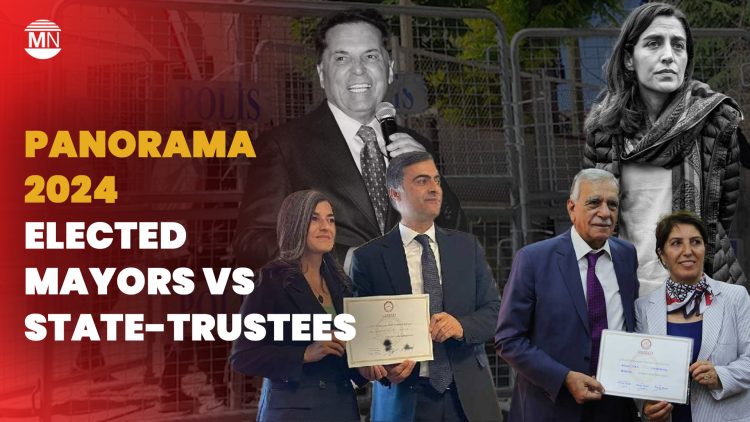
The government’s response to its electoral losses was swift and severe. State-appointed trustees replaced elected officials in several Kurdish-majority municipalities, a move denounced by opposition leaders as a “coup against the people’s will”. In Van (Wan), protests against the annulment of Abdullah Zeydan’s mayoral victory—in which he secured 55.48% of the vote—were met with police violence. Over 260 demonstrators were arrested, sparking widespread condemnation. “The government’s actions are a blatant violation of democratic principles,” stated a DEM Party spokesperson.
Related Articles :
Paris City Council demands release of detained Kurdish mayors in Turkey
Turkey: Kurdish cities protest trustee appointments, defy police blockades
In Esenyurt, one of Istanbul’s largest districts, Mayor Ahmet Özer was arrested on dubious charges, replaced by a government trustee. Nationwide protests erupted, with demonstrators demanding the restoration of democratic governance.
In Mardin (Mêrdîn), a cultural capital city of the Kurdish-majority southeast, veteran politician and elected mayor Ahmet Türk was replaced by a state trustee.
Demonstrators in Mardin (Mêrdîn) against the state-trustee, led by co-mayors Devrim Demir and Ahmet Türk, marched while chanting, “We are here to resist,” and “Jin, Jiyan, Azadî” (Woman, Life, Freedom), only to be met with a fortified police presence that blocked their access to the municipality on 13 November 2024
Cultural and linguistic suppression
The authoritarian measures extended beyond politics into cultural and linguistic repression. Kurdish road signs were removed, bilingual practices curtailed, and celebrations featuring Kurdish music resulted in arrests. These actions echo Turkey’s historical policies aimed at erasing minority identities, as outlined in documents like the 1925 Eastern Reform Plan and the 1930 Turkification Circular.
Selahattin Demirtaş, a prominent Kurdish politician imprisoned since 2016, reflected on the enduring challenges: “The Turkish state views the strengthening of Kurds through democratic means as more dangerous than taking up arms. This mindset prioritizes war and violence over political solutions.”
Gözde Çağrı Özköze eloquently captured this sentiment, stating:
“What we witnessed in Turkey’s 2024 elections was not merely a political contest but a testament to the enduring spirit of resistance. Despite arrests, violence, and decades of cultural suppression, Kurdish communities have shown remarkable resilience. They reclaimed their voice through democratic means, even when the system seemed rigged against them. This is not just about electoral victories; it’s about asserting identity, demanding justice, and showing the world that authoritarianism cannot erase the spirit of a people determined to be heard.”
A global spotlight on Turkey
International observers, including the Council of Europe, highlighted systemic irregularities in Turkey’s electoral process. Allegations of voter manipulation and targeted repression of Kurdish candidates drew criticism from human rights organisations and foreign governments. These developments have reignited debates about Turkey’s trajectory under President Recep Tayyip Erdoğan, whose administration faces mounting challenges both domestically and internationally.
A crossroads for democracy
The 2024 elections underscore the resilience of Turkey’s opposition and civil society in the face of escalating authoritarianism. Yet, the path forward remains fraught. The repressive measures targeting Kurdish municipalities and the broader opposition reveal an entrenched regime unwilling to relinquish control. At the same time, the growing cracks in the AKP’s dominance offer a glimmer of hope for those advocating for democratic reforms.
Gözde Çağrı Özköze further reflected on this struggle: “Turkey stands at a crossroads, where the authoritarian grip of Erdoğan’s regime clashes with a growing demand for pluralism and democracy. The 2024 elections revealed that even in the face of relentless repression, there are cracks in the armour of autocracy. The courage of ordinary citizens—activists, community leaders, and voters—is a reminder that democracy is not a given; it is fought for every day. This struggle is far from over, but the seeds of change have been planted, and they are being nurtured by those who refuse to give up hope.”
Turkey’s 2024 elections have laid bare the nation’s democratic aspirations and the lengths to which an authoritarian regime will go to stifle them. The coming years will determine whether these cracks in the AKP’s dominance can lead to meaningful change or if the cycle of repression will continue.
About the author and the outlet
Gözde Çağrı Özköze, an esteemed journalist with over a decade of experience, specializes in rights-focused journalism. Her work—published by independent outlets dedicated to amplifying marginalized voices—delves into issues of democracy, Kurdish rights, and women’s struggles in the Middle East. This article was originally published in Turning Point Magazine, a platform committed to providing in-depth analysis and amplifying stories of resilience and resistance across the globe.
Read the full article here with Turning Point Magazine.


