

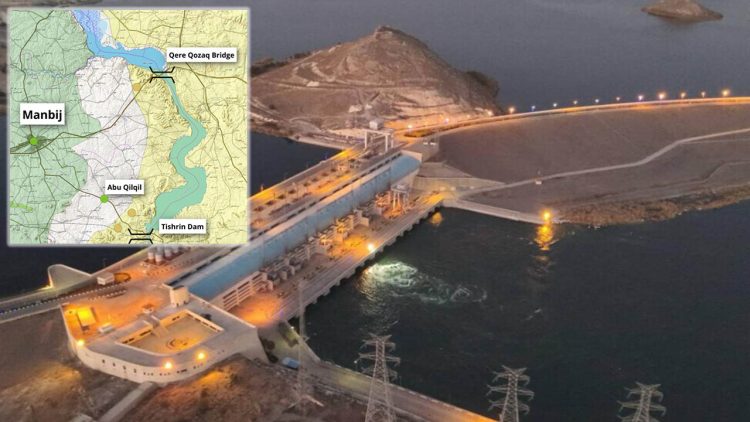
Turkish strikes escalate over strategic northern Syria sites
🔴Turkey’s strikes on Tishreen (Tişrîn) Dam and Qara Quzak (Qere Qozaq) Bridge intensify. As Rohat Baran warns, this is about trade, energy, and survival. Read more: #SyriaConflict #TishreenDam #QaraQozaq… pic.twitter.com/Yb0dN4QF61
— MedyaNews (@medyanews_) January 2, 2025
Turkish military forces and their allied Islamist militias have launched intensified strikes on two critical infrastructure points in northern Syria: the Tishreen (Tişrîn) Dam and Qara Quzak (Qere Qozaq) Bridge. These offensives, which have escalated since the beginning of the month, highlight the geostrategic significance of these locations. In an analysis published by the Fırat News Agency (ANF) on Sunday, Rohat Baran emphasises that these sites are not just vital for the local population but also hold broader regional importance in terms of trade, energy, and military operations.
Baran’s analysis points to the Qara Quzak Bridge’s pivotal location along the M4 international trade route, a corridor connecting key areas such as Kobani (Kobanê), Raqqa (Reqa), and Manbij (Minbîc). This route is essential for logistics, commerce, and defence in northern Syria. The Tishreen Dam, meanwhile, supplies electricity to vast parts of northern Syria, including Aleppo (Heleb), Deir ez-Zor (Dêrazor), and al-Hasakah (Hesekê). Losing control of these sites, Baran warns, could have catastrophic consequences for the region’s infrastructure and security.
“The defence of Tishreen and Qara Quzaq is not merely local but encompasses the security of Kobani, Raqqa, and the broader Cizre region,” Baran writes. He adds that Turkey’s strategy aims to dominate critical trade and energy resources, destabilising the region while undermining the Autonomous Administration of North and East Syria (AANES).
Control over these sites offers Turkey a range of strategic advantages. The Qara Quzaq Bridge serves as a critical juncture for military logistics, linking Kobani to the M4 route and providing access to Raqqa and further south. Similarly, the Tishreen Dam, which also works in tandem with the Tabqa Dam, is crucial for energy production and water management in northern Syria. Baran underscores that controlling the dam would allow Turkey to weaponise water resources, crippling agriculture in the Euphrates Basin and exerting economic pressure on the region.
The Turkish military’s actions are viewed as part of a calculated effort to encircle Kobani and strengthen its position for potential offensives against Raqqa and other areas under the Autonomous Administration’s control. Baran explains that by seizing these strategic points, Turkey could expand its influence in northern Syria, control the regional trade flow, and enhance its capacity for logistical and military operations. “This is about more than immediate military gains—it’s a long-term strategy to destabilise the AANES and secure Turkey’s geopolitical interests,” Baran writes.
The response from the Syrian Democratic Forces (SDF), which operates under the AANES, has been robust. Despite heavy airstrikes and artillery fire, the SDF has managed to establish defensive lines around these key locations, launching a counter-offensive near Manbij to secure the Tishreen Dam. Their resistance has also allowed a United Nations delegation to visit the dam, a symbolic victory amid the ongoing violence.
Baran highlights the significance of the SDF’s efforts, describing their defence as critical for maintaining regional stability. “The loss of Tishreen and Qara Quzaq would dismantle the region’s defence dynamics, affecting not only Kobani but also Raqqa, Jazira (Cizîrê), and beyond,” he writes. The defence of these sites, Baran adds, is not just about military control but also about preserving the autonomy and survival of the region’s communities.
The humanitarian implications of Turkey’s offensive are also severe. Residents in Hasakah are already suffering from water shortages after Turkish-backed forces seized the Elok water station. If Turkey gains control of the Tishreen Dam, these shortages could worsen, exacerbating the crisis for more than one million people. Moreover, control of the M4 trade route could disrupt regional commerce and limit the operations of international aid organisations, further deepening the region’s economic and social challenges.
Baran’s analysis underscores the broader stakes of this conflict. “Turkey’s actions reflect a strategy to consolidate power over critical resources and territories, forcing the Autonomous Administration into a position of vulnerability,” he writes. The attacks on Tishreen and Qara Quzaq are not isolated incidents but part of a larger campaign to reshape the region’s political and economic landscape.
The escalation has drawn calls for international intervention. Kurdish authorities have urged global powers to hold Turkey accountable for its aggressive tactics and to protect northern Syria’s critical infrastructure. However, as Turkish drones patrol the skies and tanks take positions near Qara Quzaq, the prospect of immediate de-escalation seems distant.
The battle for Tishreen and Qara Quzaq is emblematic of the broader struggle for northern Syria’s future. The stakes extend beyond the control of individual sites to encompass regional stability, energy security, and the survival of the Autonomous Administration’s fragile autonomy. As the conflict continues, its outcome will likely have far-reaching implications for the people of northern Syria and the region as a whole.


