

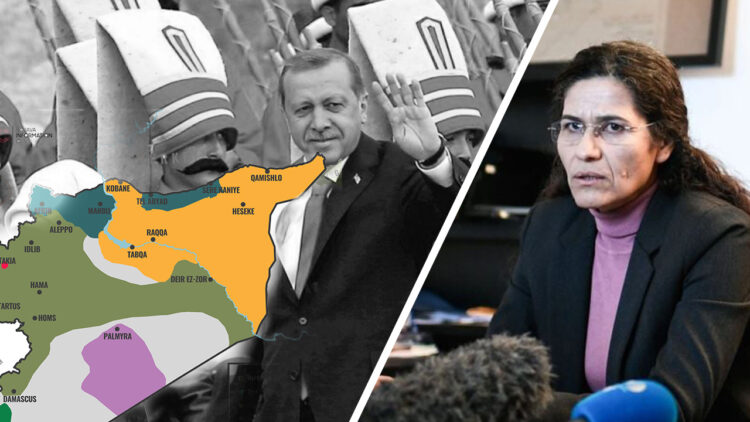
In an interview with Jacobin, Kurdish representative Îlham Ehmed and Foreign Relations Co-chair of the Democratic Autonomous Administration of North and East Syria (AANES), outlined her concerns regarding Turkey’s intentions in Syria. Speaking to journalist Justus Johannsen, she accused Turkish President Recep Tayyip Erdoğan of pursuing complete domination over the war-torn country.
Turkey wants control over all of Syria
“The Turkish state is presenting itself as the one in charge of Syria, issuing instructions and waging a policy of expulsion and war,” Ehmed said. She added that Turkey’s military offensives, which have included the occupation of Afrin (Efrîn) and other northern regions since 2018, have displaced hundreds of thousands of people, exacerbating the humanitarian crisis in the region. She said that Kurdish-majority areas are being systematically targeted to undermine the autonomous administration’s democratic governance and replace it with Turkish-backed Islamist rule.
A history of displacement and oppression
Syria’s Kurds have long faced systemic oppression under the Ba’ath regime, including forced Arabisation policies and violent crackdowns. Ehmed recounted atrocities like the Qamishli (Qamişlo) stadium massacre in 2004, where the Ba’athist government incited ethnic violence, leading to significant Kurdish casualties.
While the downfall of Bashar al-Assad’s regime in December 2023 brought hope for some, Ehmed warned that it has also unleashed new fears. Groups like Hay’at Tahrir al-Sham (HTS), with roots in ISIS and the al-Nusra Front, have filled the power vacuum, perpetuating violence and instability.
“Turkey is replicating the Ba’athist regime’s brutal methods, displacing Kurds and settling Sunni Arabs in the regions it occupies,” Ehmed explained, drawing parallels between past and present repression.
Impending threats to Kobani
Kobani (Kobanê), a city symbolic of resistance against ISIS, now faces renewed threats from Turkish-backed forces. Ehmed explained that Turkey has been attacking the city’s infrastructure, cutting off electricity and water supplies, which she interprets as preparations for an invasion.
“Kobani must be defended at all costs, as it represents the victory of all oppressed peoples against ISIS,” she asserted.
The Syrian Democratic Forces (SDF), an alliance of Kurdish, Arab and Christian groups, is mobilising to defend Kobani. However, Ehmed noted that Turkey’s ongoing aggression continues to destabilise the region and embolden ISIS sleeper cells, posing a global security threat.
Humanitarian crisis in autonomous areas
Turkey’s military campaigns have caused significant displacement, with tens of thousands of refugees now taking shelter in AANES-controlled areas. Many are living in school buildings, disrupting education and straining limited resources as winter sets in.
“The autonomous administration urgently needs international aid to address this growing crisis,” Ehmed emphasised. She highlighted the compound challenges of hosting refugees from Turkish-occupied areas alongside those fleeing Lebanon’s economic collapse and Syria’s ongoing civil war.
Ehmed also drew attention to Turkey’s use of proxy forces, such as the Syrian National Army (SNA), accusing them of committing war crimes, including looting, violence and forced displacement.
The persistent threat of ISIS
The autonomous administration continues to detain around 12,000 ISIS fighters and their families in its prisons and camps. However, Ehmed expressed alarm over Turkey’s attacks exacerbating security risks:
“We face rising dangers of ISIS breakout attempts and sleeper cell activities, worsened by Turkey’s aggression,” she said.
Despite these challenges, the SDF states that it remains committed to countering ISIS. However, resources have been stretched thin as forces are redeployed to the front lines, making the situation increasingly precarious. Ehmed warned that the resurgence of ISIS poses an “incalculable global threat” if not addressed.
A vision for democratic peace
Despite the challenges, the AANES has proposed a ten-point plan to promote national dialogue and chart a democratic path forward. Ehmed highlighted the importance of inclusive governance, saying:
“Syria’s future must involve all ethnic and religious groups, with equal representation for women.”
She drew attention to the autonomous administration’s achievements in fostering coexistence, direct democracy and gender equality as a potential model for the rest of Syria. However, she cautioned that Turkish provocations, including efforts to incite Kurdish-Arab tensions, jeopardise these efforts.
Ehmed also criticised European talks on returning refugees to Syria, arguing that the situation remains too unstable.
“Turkey should not have control of humanitarian aid channels, to portray itself as a benefactor,” she said, calling instead for a decentralised and transparent aid distribution system.
Read the full interview here:


