

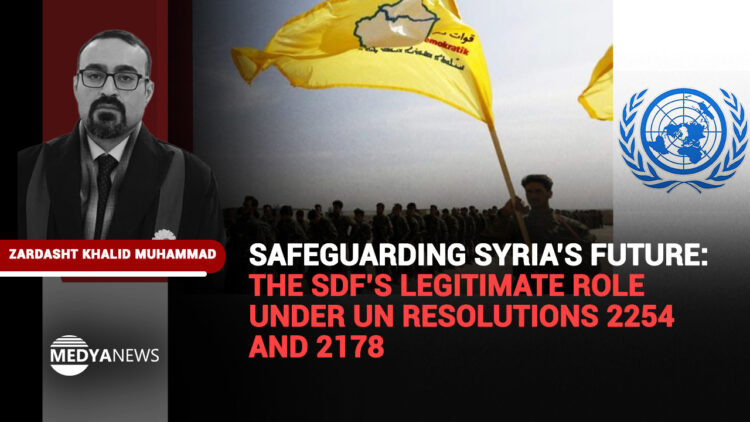
By Zardasht Khalid Mohammad
The Syrian Democratic Forces (SDF) play a foundational role in preserving the Kurdish and all other minorities presence in Rojava while striving to legitimise their international standing. Their efforts are particularly significant within the framework of United Nations Security Council Resolutions 2254 (2015) and 2178 (2014), which emphasise counterterrorism, political stabilisation, and peacebuilding in Syria.
Operating under the Combined Joint Task Force–Operation Inherent Resolve (CJTF-OIR)—established in 2014 by a presidential directive from Barack Obama—the SDF functions as a key partner of the Global Coalition Forces (GCF). This coalition, comprising 77 countries and five international organizations, serves as the operational backbone for implementing the mandates of these resolutions. As such, the SDF has emerged as the primary on-ground force supporting these international frameworks, reinforcing the legal mandates of both CJTF-OIR and the GCF.
Despite their essential contributions, the SDF’s position is under constant threat from attacks by Turkey and its affiliated groups, such as [Hay’at] Tahrir al-Sham. These forces actively undermine international efforts by rejecting the norms and principles enshrined in Resolutions 2254 and 2178. Their actions often promote extremist, Pan-Islamist narratives—such as Ottoman revivalism—that starkly contradict the principles of international law.
Turkey and its affiliates have consistently sought to delegitimise the SDF’s standing as a formal executor of these resolutions in Syria. This aggression, coupled with destabilisation attempts, directly undermines the SDF’s legitimacy and the broader international coalition’s goals. For instance, in one of his early statements, President Donald Trump controversially remarked about the Syrian conflict, “[Erdoğan] got it,” hinting at tacit approval of Turkey’s anti-SDF agenda.
The SDF remains indispensable for advancing peace, political stability, and democracy in Syria. Their efforts align with the UN Security Council’s vision of resolving the Syrian crisis through a constitutional framework, equitable power-sharing, and transitional justice for all communities and minorities. Unfortunately, the current de-facto government in Syria, led by Ahmad Sharaa, lacks the attributes of a legitimate democratic process or transitional governance. Instead, governance in Syria remains under quasi-military authority, far removed from the constitutional recognition or legal endorsement required to uphold international law.
Read More:
UN Resolution 2254: The world’s Syrian ‘get-out-of-jail-free’ card
The absence of comprehensive constitutional reform, a federal framework, and inclusive political representation continues to hinder Syria’s political transition. In the face of these challenges, the SDF’s role has been critical in preserving stability and protecting human rights in the areas under its control, often against great odds.
It is imperative for the international community to honour and support those who have fought to uphold international principles and maintain global peace and security. Since September 2014, the SDF, operating under the international coalition’s mandate, has worked to establish governance in accordance with United Nations principles and human rights norms.
The SDF’s resilience and determination remain a testament to their commitment to Syria’s future. However, continued aggression from Turkey and its affiliated groups threatens to destabilise the progress made so far. It is time for the global community to act decisively to protect and bolster the forces that have sacrificed so much in the fight against terrorism and in pursuit of a just and democratic Syria.
In these unsettled times, the enduring efforts of the SDF serve as a beacon of what is possible when international law is genuinely upheld. By supporting their legitimacy, backing constitutional reforms, and embracing dialogue, the global community can foster conditions where accountable governance and respect for human rights take precedence. Only through sustained international engagement and principled action can Syria move forward, transcending its troubled past and charting a path towards meaningful peace, stability, and democratic renewal.
Zardasht Mohammed is a freelance legal advisor based in Kirkuk, Iraqi Kurdistan. He holds a Master’s degree in Law from Indiana University in the United States. Zardasht contributes to different media outlets – and via his social media accounts (Linkedin, Facebook) – about the struggles of the Kurds for liberty, based on his expertise about international law and constitutional conventions.


