

Visual reports of the rapid advance of the Hay’at Tahrir al-Sham (HTS) group to Homs city in Syria have emerged, sparking swift and dramatic developments that have led to diplomatic interventions from key regional actors, including Iraq, Syria, and Iran, to prevent a security vacuum in the already fragile Middle East.
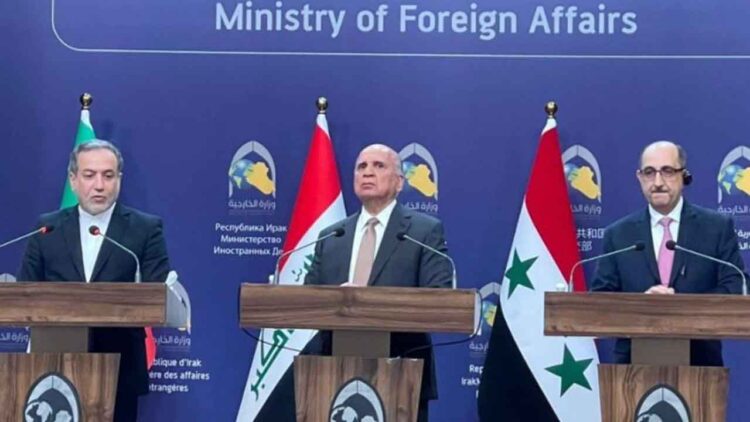
On 6 December, the foreign ministers of Syria, Iraq, and Iran convened at the Iraqi Ministry of Foreign Affairs in Baghdad for a joint press conference. They deliberated on the recent developments in Syria, highlighting the serious threats these events pose not only to Syria’s security but to the stability of the wider region.
Bassam Sabbagh, Syria’s Minister of Foreign Affairs, underscored that the dangers extend far beyond Syria, jeopardising the stability of neighbouring states. Addressing international interventions in Syria’s internal affairs, he stated: “The Syrian army continues to wage its fight against terrorist groups.”
Iraqi Foreign Minister Fuad Hussein echoed these concerns, asserting that regional security is inseparable from stability in Syria. He reaffirmed Baghdad’s unwavering commitment to safeguarding Iraq’s borders and territory against terrorism.
Meanwhile, Iran’s Foreign Minister Abbas Araghchi highlighted the delicate nature of the situation, calling for intensified consultations among regional actors to address Syria’s rapidly evolving landscape. During the press conference, he noted that Iran had held constructive discussions with Turkish Foreign Minister Hakan Fidan, emphasising the shared commitment between Iran and Turkey to Syria’s sovereignty and the pursuit of lasting peace.
This trilateral meeting coincided with Russian Foreign Minister Sergey Lavrov’s announcement that preparations were underway for further discussions with Iranian and Turkish counterparts under the Astana Process framework to review the situation in Syria.
In their final joint statement, the three foreign ministers reaffirmed their resolute commitment to Syria’s sovereignty and territorial integrity. They stressed their determination to continue diplomatic efforts aimed at eliminating threats that endanger the stability and security of the entire region.
Although regional powers continue to uphold the Astana process, it seems that, in the current context, all parties are reassessing the situation. Reviving Astana will not be an easy feat, given the lack of tangible results thus far. Political observers argue that the deep-rooted issues in Syria cannot be resolved within the confines of the Astana framework. A fundamental shift in perspective is necessary—one that confronts the reality on the ground. The internal challenges in Syria can only be addressed by involving Syrian society in a democratic nation-building process.


