

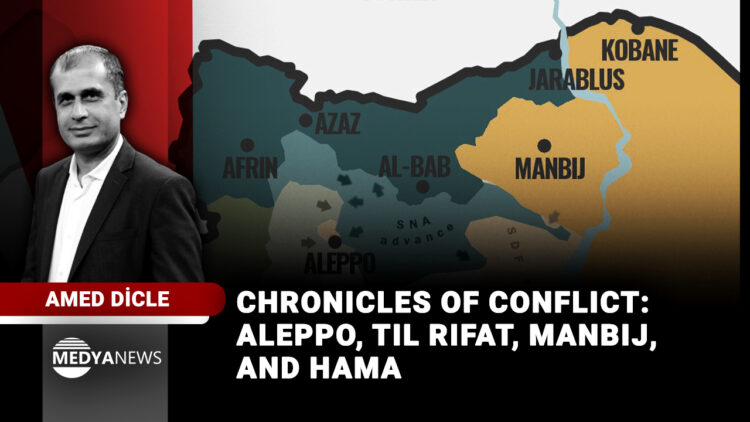
Amed Dicle
Turkey is attempting to present the situation in Tel Rifaat (Til Rifat) as a ‘victory’. However, this is a far cry from reality—a clear distortion of the truth. There is no location where Turkish-backed mercenaries have gained control by clashing with Kurdish forces.
To understand the situation, it is essential to consider the six-year-long process. When Turkey invaded Afrin in 2018, it implemented a strategy aimed at completely eradicating the Kurdish presence in the region. After the occupation, the people of Afrin were forced to settle in Shahba (Şehba) under dire living conditions, resisting under siege and embargo. They established the Afrin Liberation Forces as a self-defence armed movement there, continuing their struggle for the liberation of their lands. For this reason, the Turkish state harboured a particular hostility towards the Kurds living in this area.
During the siege of Aleppo, Turkey sought to exploit the situation to commit mass atrocities. However, the People’s Assembly decided to evacuate civilians, thwarting this plan and creating a stronger basis for military resistance. Serious operations targeting Turkish-backed jihadist groups have been ongoing since yesterday.
It appears that the evacuation process occurred within the framework of a local and international agreement. During the evacuation, Turkish-backed groups carried out attacks, although not all groups participated. Meanwhile, the international coalition contributed to ensuring safety by conducting constant reconnaissance flights along the transit route. Approximately 200,000 people were relocated to various camps, protecting them from a potential massacre.
Propaganda versus reality
The Turkish side is engaging in black propaganda, portraying itself as having achieved a ‘victory’ through combat. However, Kurdish forces have not withdrawn from anywhere other than Til Rifat. Turkey is attempting to create the perception that Kurdish forces will retreat from Aleppo and Manbij, but this does not reflect the realities on the ground.
Aleppo
In Aleppo’s Sheikh Maqsoud (Şêx Maqsud) and Ashrafieh (Eşrefîye) neighbourhoods, Kurdish defence forces and residents continue to resist. These neighbourhoods have organised themselves similarly to North East Syria’s democratic autonomous cantons, Rojava, since 2012, with their own peoples’ assemblies and defence forces. However, despite a population of approximately 200,000, the infrastructure is inadequate to support such numbers. While there is no extensive conflict currently, the withdrawal of the Syrian army from Aleppo and the siege by jihadist groups have exacerbated challenges. A potential Turkish attack could lead to inevitable urban warfare.
The infighting among jihadist groups is another noteworthy factor. Under an agreement between Turkish-backed groups and HTS (Hay’at Tahrir al-Sham), the north and east of Aleppo have been handed to Turkish-backed groups, while HTS controls the south and west. HTS has been expanding towards Idlib and Hama. However, the looting and aggression of Turkish-backed mercenaries have seemingly alienated HTS, prompting it to remove these groups from some areas.
Manbij
Turkey is preparing for an attack on Manbij. However, the Turks are aware that an offensive without HTS support would be challenging. Direct confrontation would likely result in a fierce battle. The Syrian Democratic Forces (SDF) have already conducted operations to the west of Manbij and Jarablus, disrupting Turkey’s preparations.
Manbij is seen as the first step in Turkey’s project to push Kurds to the east of the Euphrates. However, Turkey’s inadequate preparations are delaying this military operation. Ultra-right MHP leader Bahçeli’s statement that, “Next is Manbij” is seen more as an attempt to outshine Erdoğan than a reflection of genuine plans.
Hama and the southern front
Should Hama fall, the focus would shift to Homs, which is the Syrian army’s central stronghold. If Homs is lost, the Damascus and Tartus corridor could also remain at risk. For this reason, it appears unlikely that the Syrian army and its allies will easily relinquish Hama. Reports as of 4 December indicate that HTS groups have been repelled in Hama, possibly due to the Syrian army’s regrouping efforts.
What lies ahead?
The Syrian army’s progress to the south of Aleppo could alleviate pressure on Manbij. However, under current conditions, significant advancements by the Syrian army seem unlikely. Meanwhile, the SDF is preparing for a major conflict in Manbij and the Euphrates basin. In the coming days, Manbij and its surroundings will remain a focal point of interest for regional and international powers.
Amed Dicle was born and raised in Diyarbakır, Turkey. He has worked for Kurdish-language media outlets in Europe, including Roj TV, Sterk TV and ANF. His career has taken him to Rojava, Syria, Iraq and many other countries across Europe. Follow him on Twitter.


