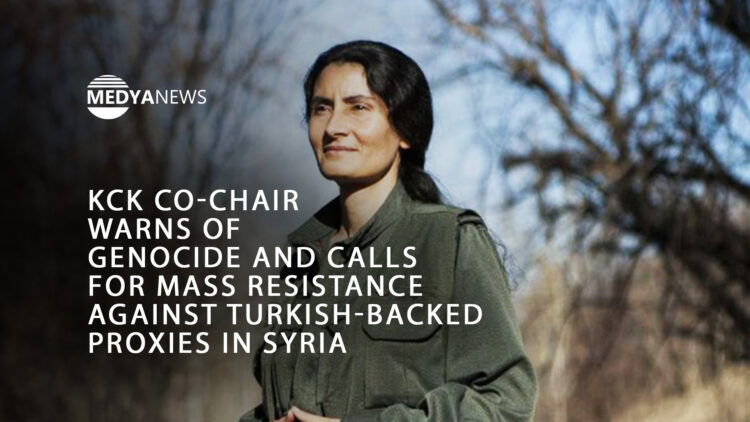
In an exclusive interview with MedyaHaber TV on 2 December, Bese Hozat, Co-Chair of the Kurdistan Communities Congress (KCK), issued a stark warning about the recent Turkish-backed offensives in Syria. Highlighting the escalating attacks by Hay’at Tahrir al-Sham (HTS) and the rebel Syrian National Army (SNA) in Aleppo (Heleb), Hozat described these operations as part of a broader neo-Ottoman strategy targeting Kurdish communities and other groups in North and East Syria.
“The Turkish state is at the helm of this war. Since 2011, Turkey has played a pivotal role in organising, arming, and commanding proxy forces like HTS and the so-called Free Syrian Army,” she said. Hozat stressed that these groups are not independent but paramilitary extensions of the Turkish army. “The generals of the Turkish military are directly coordinating the ongoing offensives, including the attacks on Aleppo,” she added.
Hozat argued that the timing of these attacks is no coincidence. “Following the ceasefire in Lebanon, Israel’s renewed focus on Syria and Iran aligns with Turkey’s plans to further destabilise the region,” she said. She accused international powers, including the US, UK, and Israel, of using HTS and other militias to implement their broader strategic goals in Syria while Russia and Iran remain weakened and distracted by other conflicts.
The recent surge in violence began on 26 November, when Turkish-backed HTS and SNA forces launched a coordinated assault on Aleppo. HTS, a former affiliate of Al-Qaeda, captured significant portions of the city with little resistance from the Syrian regime. The offensive quickly expanded, with militias advancing toward Hama and threatening to push further into Damascus.
Since 2018, Turkish-backed forces have occupied key areas in northern Syria, including Afrin, Azaz, and Tel Abyad, implementing policies of demographic change and systematic displacement. These offensives have led to widespread displacement and accusations of war crimes, including ethnic cleansing against Kurdish populations.
Hozat called for a mass mobilisation of Kurdish communities and allied forces to counter the escalating threats. “North and East Syria must declare a state of mobilisation. All individuals, young and old, women and men, must take up arms to defend their land and their freedom,” she said.
She emphasised the need for unity among Kurdish defence forces, including the Syrian Democratic Forces (SDF), People’s Protection Units (YPG), and Women’s Protection Units (YPJ), urging them to stand together against Turkish-backed proxies.
“The revolutionary people’s war* must be intensified,” Hozat declared, urging Kurdish communities globally to resist. “Our people must rise in every corner of Kurdistan and beyond to confront this genocidal campaign. We cannot abandon our land or succumb to forced displacement. Resistance is our only path to survival and freedom.”
Hozat also criticised international silence on Turkey’s actions, accusing global powers of tacit approval. “This war is not just against the Kurds; it is an assault on all the peoples of Syria. The silence of international coalitions only emboldens Turkey and its proxies,” she said.
Hozat’s statements come amid a rapidly deteriorating situation in Syria, with millions displaced and facing humanitarian crises. Her call for mobilisation underscores the urgency of collective resistance against the advancing forces, aiming to protect the hard-fought gains of the Kurdish movement in the region.
*Rooted in Öcalan’s rose theory and revolutionary popular resistance, this ideology prioritises self-defence and collective action. It has shaped the governance and defence structures in Rojava, now officially known as the Autonomous Administration of North and East Syria (AANES). These principles enabled the Kurdish-led administration to resist threats from regional and international forces, including their critical role in defeating ISIS and countering Turkish offensives.