

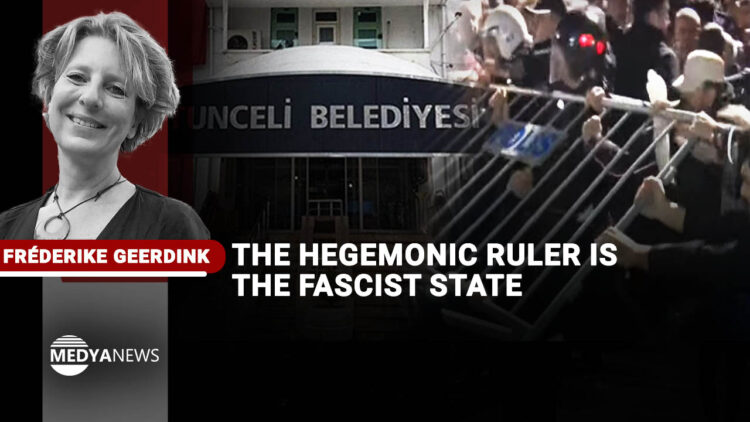
Can we still call Turkey a competitive authoritarian regime?, a policy analyst and former Turkish diplomat asked on Bluesky after the democratically elected co-mayor of Dersim was replaced by an AKP ‘trustee’. An exchange emerged and the answer was ‘yes’, because the opposition was still able to win elections. An academic article about competitive authoritarian regimes was shared. I read it, with the Kurds in mind.
Not only the co-mayor of Dersim was replaced: the co-mayor of Ovacık met the same fate. This happened after earlier this month, the mayors of Batman, Halfeti and Mardin were replaced by AKP stooges. Before that, the mayor of Esenyurt in Istanbul was sacked and replaced, and much earlier already, this happened to the mayor of Hakkari. As DEM Party MP Sezai Temelli said in parliament, after a village head in Ardahan province, in Turkey’s northeast, was replaced: “The trustee virus is spreading faster than Covid.”
Violations
Now that we have the recent facts straight, let’s look at ‘competitive authoritarianism’. It is described as a system with formal democratic institutions but with a government that violates the rules of those institutions. The rules are violated to such an extent that the system fails to meet conventional minimum standards for democracy. The violations of democratic standards (like open, free and fair elections, the general right to vote, respect for political rights and civil liberties like press freedom and freedom of association, and absence of military or clerical tutelage) are too frequent and serious to speak of a level playing field between government and opposition.
Still, it is not full-blown authoritarianism because despite the lack of a level playing field, the opposition still has a chance to win elections and overthrow the regime – hence the ‘competitiveness’. It can do that by wrestling out space via for example the remaining independent media, or via available wiggle room in parliament or judiciary. It remains to be seen what comes next though if a competitive authoritarian regime is toppled: a road towards democracy, or a road towards more authoritarianism.
Break-through
Does the opposition in Turkey indeed have the opportunity to win elections? Depends on what you call the opposition, and whether you are talking about the local or the national level.
On a local level, the opposition, however you define it, can certainly win elections. Also before the AKP came to power in the beginning of this century, this was the case. Regions have their preferences, with – broadly sketched – the Black Sea Coast as ultra-nationalist, the Aegean Coast as Kemalist, the Anatolian heartland as pious, the southeast as Kurdish. And throughout the AKP’s rule, municipalities have been ruled by opposition parties, the CHP and whichever the local Kurdish party was, and even the short-lived ultra-nationalist IYI Party has won municipalities.
A break-through during the AKP reign happened in 2019, when both Istanbul and Ankara were taken by the CHP, with both mayors securing their seats again in the local elections this year. This has given hope to many people in Turkey who vehemently oppose the AKP-MHP government and the increasing authoritarianism. Can they win at the national level too? Well, they couldn’t in 2023, partly because of the lack of level playing field. But yes, there is hope.
Civil rights
Hope for whom? For CHP voters, but not for those in Turkey who resist the government on a much broader level. You know whom I’m talking about: the Kurds, at least the Kurds who are active in or support the movement that is fighting for their basic civil and political rights. They know that a change from AKP-led government to CHP-led government doesn’t necessarily solve their problems.
This puts the concept of ‘competitive authoritarianism’ and it’s applicability to Turkey in a new light. The opposition can still win elections, but not the opposition that wants to solve the core problem of the state, which is – we have to use the word – fascism. The Kurdish party, currently DEM Party but before HDP, BDP and others, can win elections on a local level because they operate as part of a mass peoples’ movement. This movement is heavily suppressed, but it keeps resisting and the voters believe in it. That’s why they so strongly resist when a ‘trustee’ takes over: they want their local victories to have actual meaning.
Signals
But the DEM Party can not win the general elections on a national level. The system, of which all other political parties are strong supporters, won’t allow it, with all the institutions and media in their hands. Hence, Turkey can’t be judged as being in a state of ‘competitive authoritarianism’. Instead, it resembles ‘hegemonic authoritarianism’ much more. The hegemony is the system that has categorically excluded, denied, suppressed and murdered Kurds it since the first days of the republic in 1923. The hegemonic ruler is not the AKP-MHP government, but the fascist system it serves. The CHP would do the same – at least, I see no signals that it wouldn’t.
I found an interesting article on this form of authoritarianism, more specifically about how they simulate pluralism with democratic language: seems to be exactly what the established parties in Turkey have been doing since decades.
The Kurdish movement knows very well it can’t win the elections and rob the hegemonic powers of their parliamentary power via the ballot box. So they resist and struggle. That’s where the hope is against fascism.
Fréderike Geerdink is an independent journalist. Follow her on Bluesky (or X) or subscribe to her acclaimed weekly newsletter Expert Kurdistan.


