

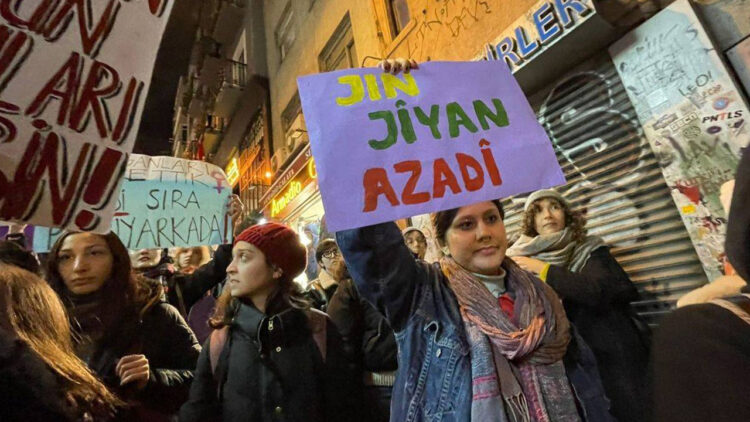
Women’s rights activists in Turkey’s city of İstanbul defied governmental restrictions on the International Day for Elimination of Violence against Women, facing widespread police intervention while demanding fundamental freedoms and challenging systemic oppression.
Organised by the 25 November Women’s Platform, women gathered at Karaköy Pier, delivering press statements in Turkish, Kurdish and Arabic. Despite İstanbul Governor’s office and Police Department attempting to blockade Taksim and prevent gatherings, women persistently mobilised across different locations, chanting “Jin, Jiyan, Azadî” (Woman, Life, Freedom).
Last week the governorship of Diyarbakır (Amed), in the country’s southeast, attempted to ban the ‘Jin, Jiyan, Azadî’ slogan, alleging it constituted ‘organisational propaganda’, sparking controversy. Without presenting official documentation, local security forces contacted women’s groups to prohibit the use of the slogan ahead of a planned event.
Free Women’s Movement defiant as Turkish governor bans Jin Jiyan Azadî slogan
Pro-Kurdish Peoples’ Equality and Democracy (DEM) Party Co-Chair Tülay Hatimoğulları condemned the prohibitive approach, stating, “No one has the right to ban the slogan that has spread from the Middle East to the entire world, embraced by Kurdish women and women worldwide.” Peoples’ Democratic Congress (HDK) Co-spokesperson Meral Danış Beştaş highlighted the resistance, emphasising that “thousands of women have crossed numerous barricades to be here, and our struggle against violence will not retreat”.
Police responses were aggressive, with 169 women detained across multiple locations. At Minerva Han, officers used pepper spray, to which protesters responded by throwing purple paint. Women’s groups consistently chanted “Human dignity will defeat torture” and continued their demand for bodily autonomy and freedom.
The protesters explicitly denounced various forms of violence, including physical, sexual, psychological and economic oppression, holding both individual perpetrators and state mechanisms accountable for systemic gender-based violence.


