

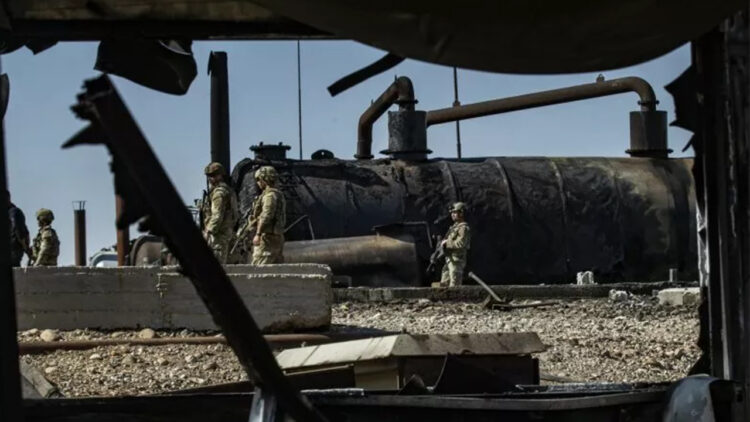
Various commentators suggest that Donald Trump will withdraw US forces from northeastern Syria. On 8 November, Robert F. Kennedy Jr told political commentator Tucker Carlson that Trump intends to pull American troops from the region to prevent them from becoming “cannon fodder”.
Four days later, Turkish Defence Minister Yaşar Güler stated in an interview, “Trump gave instructions to withdraw troops from Syria three times during his presidency.” He expressed confidence that Trump would prioritise this issue and remove US forces from Syria and the broader region.
However, given the transformed political landscape of the Middle East since Trump’s first term, it remains unclear whether such a promise holds in the present context.
Joshua Landis, Director of the Center for Middle East Studies at the University of Oklahoma, observed in a TNA interview that the Trump administration’s “Iran hawks” are likely to resist his inclination to withdraw US troops from Syria. While Robert Kennedy Jr has asserted Trump’s intention to pull out, most consider these forces vital to countering Iran and bolstering Israel’s position in the region. He further stated that the US presence in the Middle East will remain a battleground of opposing domestic and international pressures. Although Trump supporters exhibit isolationist tendencies, influential voices, especially from Israel, are expected to prevail in sustaining a robust posture to contain Iran across the region.
Meanwhile, Michael Rubin has warned Trump against withdrawing the approximately 1,000 US troops stationed in the Autonomous Administration of North and East Syria (AANES), urging the need to view such a move through the lens of Turkey’s growing radical Islamist trends. Rubin highlighted:
“Erdogan is open about his Hamas support. With Qatar expelling Hamas leadership against the backdrop of their bad-faith approach to hostage negotiation, Turkey could be Hamas’s next headquarters. Hamas not only receives Turkish financial support and safe haven, but Erdogan also allows it to plan terrorist operations from Turkish territory. Nor is Hamas alone. The Islamic State, Chechen rebels, Al-Shabaab, and Kashmiri terrorist groups all find Turkey-friendly territory. Islamism is rampant in Turkey. Erdogan, a staunch Muslim Brotherhood acolyte, has transformed confiscated Gulenist properties into hubs of radicalisation. This ideological transformation deepens the complexities of withdrawal considerations.”
Since 2012, Erdoğan has justified military operations against the PKK by targeting northeastern Syria’s infrastructure. Recently, Erdoğan told Newsweek, “Turkey’s war is not with Syrian Kurds but with PKK-linked terrorists, supported by the US, who threaten Kurds, Arabs, and Turkmens in the region.” He pledged to continue combating the PKK, its affiliates, and ISIS to ensure peace in Syria.
However, Kurdish fighters in the AANES remain wary of Trump’s potential return, recalling the painful experiences of 2018. Sinam Mohamad, the Syrian Democratic Council’s envoy to Washington, D.C., told Newsweek, “We endured a frustrating period when Washington’s withdrawal exposed us to Turkish threats, resulting in occupied territories. Despite this, we are optimistic about President Trump’s return and hope he adopts a more positive approach this time.”
Russia and Iran persist in calling for a complete US withdrawal from Syria, whose government remains unrecognised by the US and subject to Western sanctions. Though aligned in supporting Damascus, Moscow and Tehran occasionally diverge in their visions for Syria’s future. Notably, Russia has refrained from preventing Israeli strikes within Syrian territory.
“The Autonomous Administration (AANES) maintains communication with both American and Russian forces present in the region. While past interactions have been challenging, we believe a renewed American-Russian rapprochement could significantly influence the Middle East’s stability,” Mohamad elaborated.
The possibility that Trump’s Middle East policies will centre on curbing Iran, countering a resurgent ISIS in Syria, and addressing Erdoğan’s support for Hezbollah and the Palestinian groups, especially Islamist ones, alongside the ongoing Israel-Hezbollah conflict, could significantly influence his decision to withdraw US forces from northeastern Syria. Notably, while maintaining such a presence entails substantial financial costs for the US, these troops serve as a critical counterbalance to Russian and Iranian influence in the region.


