

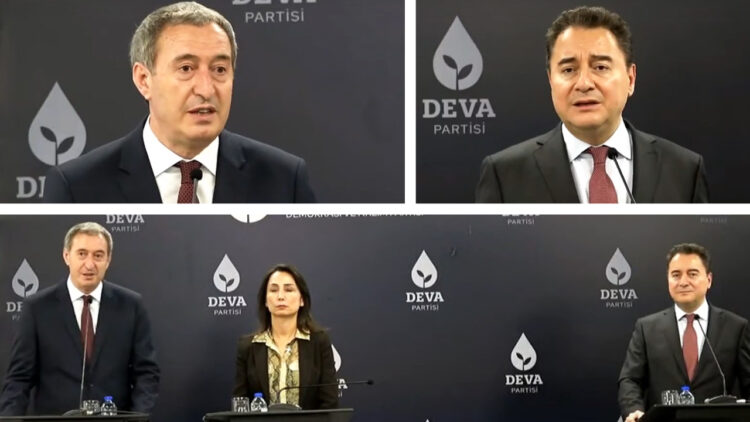
Former Finance Minister and current Democracy and Progress (DEVA) Party leader Ali Babacan expressed willingness to support even minimal progress in addressing Turkey’s Kurdish issue, cautioning against unrealistic expectations during opposition talks held in Ankara on Saturday.
Speaking at a joint press conference with pro-Kurdish Peoples’ Equality and Democracy (DEM) Party Co-chairs Tülay Hatimoğulları and Tuncer Bakırhan, Babacan addressed controversial political developments, including trustee appointments to municipalities and pathways to resolving the Kurdish issue.
“We would support even a 5-10% possibility of resolution if we see genuine effort towards a solution,” Babacan stated, underscoring the need for concrete actions beyond rhetoric. He criticised the absence of a clear political stance from President Erdoğan’s administration.
Bakırhan welcomed Babacan’s remarks but urged a break from past failed approaches. “The transformation of these discussions into democratic solutions for the Kurdish issue is what we desire,” he emphasised.
Both leaders condemned the recent trustee appointments to municipalities, with Babacan describing them as “contrary to basic democratic principles”. DEVA Party’s legal team is collaborating with other parties to challenge the legislation that permits such appointments.
Bakırhan cautioned against treating the Kurdish issue as a political bargaining chip. “If there’s an intention to instrumentalise this matter, we won’t allow it. We have the experience and a clear stance from the past,” he declared.
Addressing broader concerns, Bakırhan highlighted the opportunity for Turkey to position itself as a regional model by resolving internal issues democratically. “Turkey faces a serious economic crisis and significant challenges regarding democracy and the rule of law,” he said.
Ali Babacan is the founding leader of the DEVA Party, established in 2020. A former member of the ruling Justice and Development Party (AKP), Babacan served as Minister of Economy, Foreign Minister and Deputy Prime Minister during his tenure in government from 2002 to 2015. Known for his technocratic approach, he played a key role in steering Turkey’s economy during a period of growth in the early 2000s. Babacan left the AKP in 2019, citing a divergence from democratic values, and has since positioned DEVA as a reformist opposition party advocating for democracy, human rights and economic stability.


