

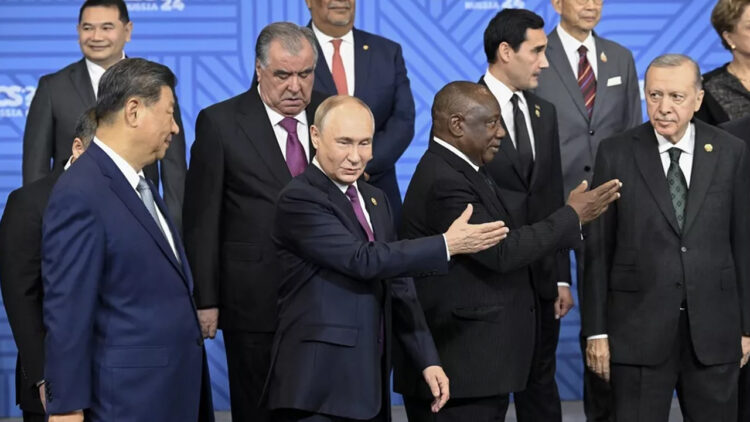
The BRICS group has introduced a “partner country” status, as outlined in the Kazan Declaration on 23 October 2024. Turkish Trade Minister Ömer Bolat announced on 14 November that Turkey had been offered this designation—a symbolic gesture that appears to fall short of Ankara’s ambitions for full membership.
Speaking to TVNet, Bolat stated, “As for Turkey’s status regarding (BRICS) membership, they offered Turkey the status of partner membership. This status is the transition process in the organisational structure of BRICS.”
He dismissed claims that India had blocked Turkey’s full membership due to Ankara’s close ties with Pakistan but acknowledged that the offer reflects a compromise rather than outright acceptance.
President Recep Tayyip Erdoğan, who attended the BRICS summit hosted by Vladimir Putin in Kazan last month, has presented BRICS as an opportunity for economic cooperation with emerging economies. However, critics argue that Turkey’s aspirations to diversify alliances often lack substantive outcomes, with the partner country status offering little in terms of actual influence within the bloc.
BRICS, comprising Brazil, Russia, India, China, South Africa and new members such as Ethiopia, Iran, Egypt and the UAE, represents nearly half the world’s population and a third of global GDP. Unlike NATO or the EU—organisations where Turkey seeks deeper integration—BRICS functions as a platform for cooperation without binding economic commitments.
The bloc positions itself as a counterweight to the Western-led global order, with ambitions to challenge the dominance of institutions such as the UN, IMF and World Bank, while exploring alternatives to the US Dollar. Yet, Turkey’s potential inclusion as a “partner country” risks being perceived as a superficial alignment rather than a significant step forward.
Notably, Turkey would be the first NATO member to join BRICS—a bloc at odds with the West over numerous issues, including the Middle East conflict. Nonetheless, this partner status underscores Ankara’s tenuous position in its quest to straddle Eastern and Western alliances, highlighting its struggle to secure full membership in either sphere.


