

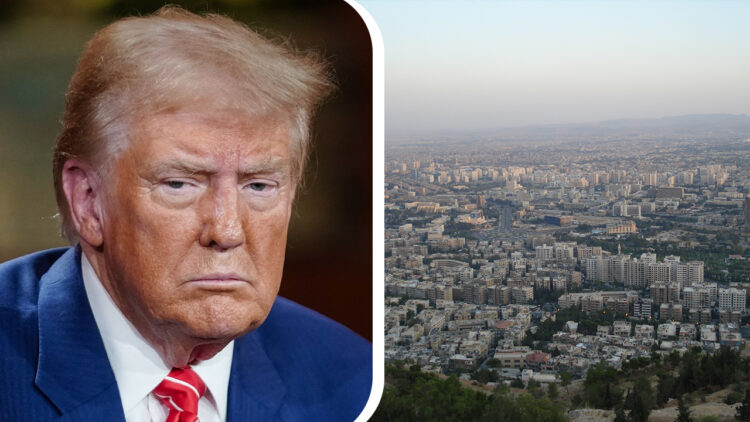
An article by Ahmet Aktaş, published in the Welat newspaper, analyses the possible consequences to the Middle East of US President-elect Donald Trump’s re-election, especially in light of his promises to stop the ongoing wars and of the close cooperation between the USA and Israel. In the framework Aktaş describes, Turkish President Recep Tayyip Erdoğan will have to clarify his stance towards the new US administration. Nevertheless, the writer stresses that the organised power of the Kurdish people will be a decisive element in the coming developments.
Read a translation of the article below:
Has he come for good or for war? Before the elections, Trump said, “If I am not elected, World War III will break out.” He also said, “If I’m elected, I’ll stop the Ukrainian war,” ostensibly saying, “I am a pacifist, I don’t want war.”
He did not, however, put the issue of peace on the agenda with Israel. And with [Turkish President] Recep Tayyip Erdoğan, Trump was sometimes gentler, sometimes more rigid, but for the most part their relationship was not good – like on the issue of Turkey’s purchase of S-400 missiles from Russia, its withdrawal from the F-35 programme, the imprisonment of Pastor Andrew Brunson, Halkbank, Reza Zarrab and many other examples…
Trump had disagreements with many European and world states, he even had differing views from NATO. But, as is well known and oft-repeated, no matter who becomes president of the US they cannot conduct policies according to their own views. Yes, Trump can have a small influence on policy, but basically he has to act in accordance with the current policy of the state.
So it seems that US policy will continue in its current form, in the world in general and in the Middle East in particular, and Trump’s individual policy will not be far from that same policy.
Yes, he may say “I will stop the war” in regions such as Ukraine, evidently in that region the war is at an impasse, but on other fronts like the Middle East, there is no sign of the war abating.
Let us take note, the first to congratulate Trump’s victory were [Israeli Prime Minister Benjamin] Netanyahu and Erdoğan. Obviously, these two lead the war in the region (Trump and Netanyahu are said to have discussed Iran in their recent phone call).
Let us remember that during his first term, Trump said, “If Iran wants to fight, that will be the official end of Iran.” So it seems clear that Trump’s attitude and views are not about to change. Of course, Netanyahu does not hesitate in this matter, but carries out his own attacks against Iran and its accomplices rapidly and incessantly. It is Erdoğan who is stalling here and is afraid of the consequences.
So it is clear with regard to this [potential attack on Iran] that Trump will put pressure on Erdoğan, who in turn is in need of US support in order to extend his rule.
Certainly, in this context, it is not only Netanyahu and Erdoğan that the US needs, and maybe it needs the power of the Kurdish people even more – those who have the strongest organisation and the will of the people are the PKK [Kurdistan Workers’ Party], PYD [Syria’s Democratic Union Party], PJAK [Iran’s Kurdistan Free Life Party], among others.
There is a strong prediction that in the coming period, Trump will make an agreement with Russia vis-a-vis Ukraine, and they will stop the war for a time, and make peace.
In taking this step, he creates a broad front against Iran; under the vanguard of Israel, Turkey and many Arab states, and with the Kurdish Freedom Movement, the power of the Kurdish people, he will intensify the war and crush Iran’s Islamic regime.
By this method, he will break Iran’s influence on the whole Middle East and will be able to carry out his own global plan more easily, especially in Syria.
Of course, with this modern and unique strategy, he will strengthen his own hand against China, his biggest and most fundamental goal.
As a result, it can be said that if there are no unfortunate or inconvenient mistakes amid all the dangerous developments, there may be even more opportunities for the revolution of the Kurdish people.
Ahmet Aktaş is a writer of Kurdish origin, born in the Kurdish-majority city of Mardin (Mêrdîn) in south-eastern Turkey. He headed the Kurdish Institute in Germany for more than 10 years, leading research and teaching on the Kurdish language. He currently writes articles in the Kurdish newspaper Welat.


