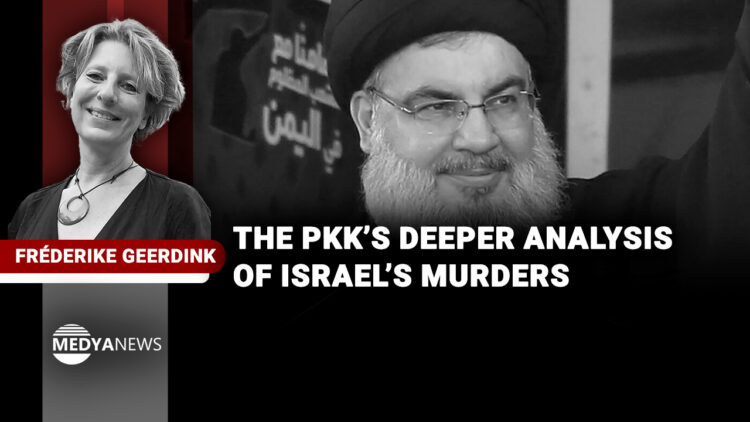
Fréderike Geerdink
The impact that the murder by Israel of Hezbullah General Commander Hassan Nasrallah will have across the region, is widely discussed. Practically every political actor has reacted to it, also Kurdish ones. It’s interesting to take a closer look.
I will not comment on the backgrounds and possible consequences of the assassination of Nasrallah, nor on his legacy, simply because that’s really not my expertise. From the articles I read about it, I’m especially impressed by this one on Newlines. But the reactions of several Kurdish actors are rather telling about their positions in the Middle-East – let’s take a look.
Consistent
Peoples’ Equality and Democracy Party (DEM Party) in Turkey and Bafel Talabani of the Patriotic Union of Kurdistan (PUK) in the Kurdistan Region in Iraq were the first to react. DEM Party’s co-chairs Tülay Hatimoğulları and Tuncer Bakırhan criticised the murder, and said that it only deepens the crisis in the region. “This aggression”, they said, “which is forcing Palestinians from their homes and killing civilians in Lebanon, will not bring peace but will fuel the cycle of violence.” They added: “We will continue our efforts for peace and invite all Middle Eastern peoples to unite in the struggle for a future free from violence.” Pretty consistent: DEM Party always focuses on the P-word (which can get you jailed in Turkey) and the need for political solutions and calling on the international community to interfere.
PUK’s Bafel Talabani too called for the international community to act. He referred to Nasrallah’s death as the ‘martyrdom of His Eminence Sayyed Hassan Nasrallah’, and extended the PUK’s ‘heartfelt condolences to the bereaved family, the people of Lebanon, Muslims worldwide, and the comrades of the deceased for this immense loss’. That’s a bit more than diplomatic courtesy: the PUK has ties to Iran like KDP has ties to Turkey, and Talabani’s words reflect that.
Referendum
The Kurdistan Region’s presidency (read: Kurdistan Democratic Party or KDP) urged all parties to ‘act with wisdom and restraint’ to prevent further deterioration and to safeguard regional stability. The KDP’s softer reaction is connected to the party’s problematic relations with Iran, which has bombed targets in KDP’s territory several times over the years, (baselessly) claiming the targets were ‘Mossad bases’. The KDP has reasonably good ties with Israel, the latter using the Kurds’ aspirations for freedom to advance its own goals in the region. Surely, KDP has not forgotten that Nasrallah fiercely rejected the Kurdistan independence referendum in 2017, calling it a ‘US-Israeli project’ (which it wasn’t).
There was no immediate statement from the Kurdistan Communities Union (KCK), the umbrella under which the Kurdistan Workers’ Party (PKK) also resides. When Hamas’s Ismail Haniyeh was assassinated, I asked them about it for my weekly Kurdistan newsletter because no specific statement had come. The spokesperson said: “Ismail Haniye’s legacy and personality profile, as well as the relations he had with regional factors, do not fit into the context of the legitimate struggle of a society fighting against the repression of a particular state. He may have some degree of public support among the people in Gaza, but in the long term, his struggle relies on the support of the states for survival. For this reason, KCK didn’t feel the need to issue a statement in particular about him. May be, in the future, KCK will, in some way, tap into the issue and assess and evaluate the course of the events that unfolded around his person and the group he represented.”
Occupations
Soon, an interview with KCK co-leader Besê Hozat was published, and that definitely tapped into the issue, deeply. It was actually the most profound analysis I read. She said that the Turkish intelligence agency MIT was involved in the murder, and added: “It seems that this attack was a joint plan of Mossad, the CIA, and MIT.” I’m not sure what to think of it to be honest, as she presented no proof. But the context she sketches is interesting and rather convincing: this could lead to a war between Israel and Iran, which would benefit Turkey, which would take advantage of such a war to further expand its occupations in the region. It’s part of Erdogan’s ‘Ottoman dream’.
The assassination of Nasrallah fits that scenario: Hozat already said that Lebanon would probably be next, and then Syria, and the Israeli invasion of Lebanon is currently happening. So, what does this say about the KCK’s position? For one, that the KCK doesn’t need to please any state with their statements and views because they are not existentially tied to a state but act independently. But the geopolitical analysis is also closely tied to the solution the Kurdish movement proposes. A solution that addresses both the Kurdish and the Palestinian issue, and the tensions, violence and wars in the whole region.
Because of course, the KCK supports the plight of the Palestinians. The spokesperson told me that it regards Israel’s attacks against the Palestinians and particularly against the civilians in Gaza as a heinous act of genocide. He wrote: “As the Kurdish Freedom Movement, we support the Palestinians’ cause for freedom, for living a free life on their free land.” And he brought up the solution: democratic confederalism.
Borders
When I explain democratic confederalism in a Kurdish context to people who are beginners on the subject, I point out that no, the Kurdish armed movement is not fighting for an independent Kurdish nation-state. They are against nation-states, as they don’t do justice to the ethnically, religiously, linguistically and culturally immensely diverse fabric of the Middle-Eastern societies. Better would be a system that gives real power to local communities to govern themselves in a loose confederalist structure. Such a model undermines existing nation-states and eventually renders their borders obsolete.
Explaining the system in the context of Palestine and Israel, I would sum it up as: think of it as a no state solution, with hegemony for nobody, erasing borders and walls and giving everybody full rights. Unrealistic? Well, the one-state solution Israel has been trying to create since 1948 isn’t working out particularly well, to say the least, and a two-state solution isn’t considered realistic anymore either.
A short, quick statement on the assassination of Nasrallah? I’m not holding my breath. Maybe it’s superficial to wait for it, even. The wider analysis into which these murders fit, gives a much deeper understanding.
Fréderike Geerdink is an independent journalist. Follow her on X (Twitter) or subscribe to her acclaimed weekly newsletter Expert Kurdistan.