

Introduction
Turkish President Tayyip Erdoğan’s numerous policy U-turns, often seen as inconsistent, are part of a deliberate strategy to retain power and suppress Kurdish autonomy, argues M. Ender Öndeş. Despite reversals in foreign relations with Syria, Egypt, the UAE and Saudi Arabia, Erdoğan’s steadfast stance on the Kurdish issue and political prisoners remains unchanged, reflecting his long-term political goals. We have translated M. Ender Öndeş’s article, first published in the Yeni Yaşam Newspaper, in full below. Click here for the original article.
“Me, me, me! As long as I’m in charge of this mission…”
M. Ender Öndeş
The most striking thing that historians will find when they study the AKP’s president, Tayyip Erdoğan, and his team – who have managed to stay in power for 22 years using everything from electoral fraud to repression and intimidation – will be Erdoğan’s quick ‘U-turns’ and his contradictory words and actions. But it is not all about personal inconsistency. While spokespersons for the mainstream opposition interpret these rapid changes as political incompetence or a kind of madness, this is highly debatable. Although Erdoğan has often stumbled in his political career, he has never, from the very start, deviated from two basic principles: Staying in power and pursuing a policy of repression to create a climate of fear, especially regarding the Kurdish issue and other societal problems. In fact, the two are closely linked. While Erdoğan is trying to prevent the Kurds from gaining even the most limited status anywhere at all, he is also trying to rule over the Kurdish society, which has been forced into disorganisation, and turn it into a subjugated people, while the goals of oppressing the Kurds and those of maintaining power have become intertwined. Therefore, his U-turns, which from the outside may look like the vacillations of an amateur politician, can always be understood in relation to the Kurdish issue.
Particularly in foreign policy, the background of the most critical moves and U-turns has always been to pave the way for expansionist ambitions in North and East Syria and the Kurdistan Region of Iraq.
From ‘Assad the murderer’ to ‘normalisation’
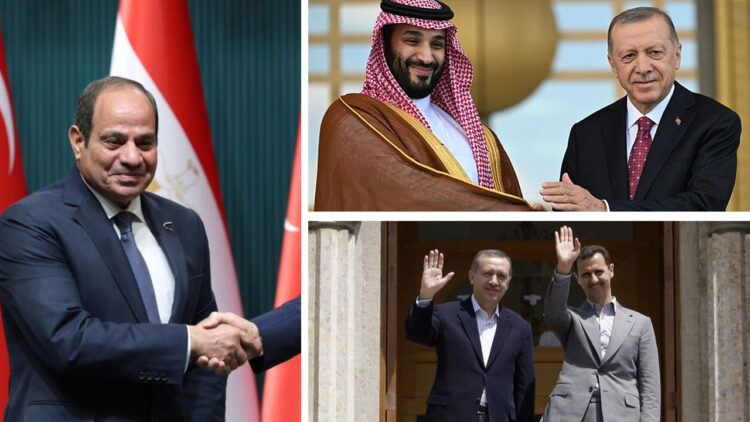
One of the most typical examples of this was Erdoğan’s relationship with the Syrian regime. Bashar al-Assad, once ‘my brother Assad’, became ‘Assad the murderer’ overnight when Turkey, along with other international powers, intervened in Syria in 2011 and Erdoğan wanted a piece of the cake. In his imperialist fantasies, Erdoğan treated Syria as the land of the Ottomans and therefore his own and he intervened by organising the jihadist forces in the region saying, “Oh Bashar Assad, I swear you will be held accountable for this. If Allah wills it, we will see this murderer pay in this world.” Meanwhile, he had an important plan to annex the region by buying off the Kurds of Rojava. But everything was turned upside down when the Kurds maintained their independence and started to build a new life in the region. Erdoğan was frustrated in his intentions to overthrow Assad and pray in the Umayyad Mosque [in Damascus], so he turned all his jihadist forces against the Kurds.
When this also proved to be unsuccessful, as in Kobanê [Ayn al-Arab], Erdoğan tried physical occupation of parts of the region and a general attack on Kurdish autonomy as a means of solving the ‘problem’. However, when it became clear that the Kurdish resistance and the international situation meant this was insuffucient, Erdoğan began to dream of cooperating with the Damascus regime in a joint destruction of the Kurdish status. By 2024, the rhetoric was about ‘normalising relations’ and ‘returning Turkish-Syrian relations to what they were’. Though ‘brother’ Assad remains cold, insisting that Turkey must ‘withdraw its troops first’ even as he establishes relations with it, Turkey keeps alive the hope of crushing the autonomous administration in Rojava by attacking on two fronts.
When did Sisi become a ‘brother’?
Erdoğan, who has never hidden his relations with the Muslim Brotherhood and his ambitions to become its leader, used the sharpest words after Abdelfattah al-Sisi’s coup: “I have stated on international platforms that I do not recognise coup leader Sisi as president. For me, Mursi is the president of Egypt. If I were to sit at the same table with him, I would be denying myself.” During the 2019 local elections in Istanbul, Erdoğan even said, “On Sunday, will we say Sisi or Binali Yıldırım [a previous Prime Minister of Turkey]?” However, in September 2023, the same Erdoğan met with Egyptian President Sisi – whom he had previously described as a ‘tyrant’, ‘pharaoh’ and ‘coup leader’ – during the opening of the World Cup in Qatar. Not only that, but he also received Sisi in Ankara a few days ago, saying at the meeting: “We are continuing to develop our cooperation. We are constantly strengthening the bridges and multifaceted relations between our countries,” underlining the goal of increasing the volume of trade between the two countries from $10 billion to $15 billion in five years.
From funding a coup to collaboration
Another link in the chain of Erdoğan’s recent U-turns with Middle Eastern countries is the United Arab Emirates. Following the coup attempt [in Turkey] of July 2016, Erdoğan claimed, “We are well aware who in the Gulf was happy with the coup attempt and how much money was spent on it.” The then interior minister, Süleyman Soylu, even openly said in 2021, “The UAE, along with the US, were responsible for the coup of 15 July. The people who carried out [the coup of] 15 July are hiding in the US, and their partners are in the United Arab Emirates.
Over time, however, hostile policies towards the UAE gave way to warmer relations, and in 2021 Turkey signed 10 agreements with the UAE in areas such as energy, environment, finance and trade. Another 13 agreements worth $50.7 billion were signed between the two countries in 2023.
‘We are not fools’
While Erdoğan was on the one hand making plans and taking action aimed at ending the Kurdish movement in Rojava and the Kurdistan Region [of Iraq], he realised that it was not wise to fight with everyone in the region. He began to make U-turn after U-turn. The search for legitimacy and support for his war against the Kurds has always been a focus, even in the most serious crises. One of these crises was the Khashoggi case involving Saudi Arabia. Following the murder of journalist Jamal Khashoggi in the Saudi consulate in Istanbul on 2 October 2018, Erdoğan had addressed the Riyadh administration saying, “These people think the world is full of fools. This nation is not foolish and knows how to hold them accountable. Much more will come to light. Much more will come out. We cannot tolerate these people anymore.” But this anger was short-lived. Some time later, ‘normalisation’ began between Turkey and Saudi Arabia. The Khashoggi case was handed back to Saudi Arabia. Five days before the arrival of Crown Prince Mohammed bin Salman in Turkey, it was announced that Istanbul’s Severe Penalty Court No.11 had dropped the case. Four years after his death, Erdoğan received Crown Prince Mohammed bin Salman with ceremony and signed several agreements between the two countries.
No U-turn, but blackmail
The recent Sweden-NATO crisis is a typical example of a case directly related to the Kurdish situation. Enjoying the leverage he had over Sweden’s NATO membership bid, Erdoğan tried to extract as many concessions as possible throughout the process. At the same time as forcing the US’s hand on the issue of fighter jets, he also tried to break Sweden’s stance on the Kurds and refugees – and he succeeded in this with Sweden at least. In January 2023, Erdoğan said to Sweden, “Sorry! You won’t get any support from us on NATO.” But in December 2023, the bill to ratify Sweden’s NATO accession protocol passed through the [Grand National] Assembly [of Turkey] and was approved.
The only consistent issue: The Kurds
Through all these years, one thing has to be admitted: Erdoğan has never made a U-turn on the war against the Kurds and the issue of Kurdish prisoners. From the very beginning, he has openly declared that he will not release thousands of Kurdish political prisoners, including HDP [pro-Kurdish Peoples’ Democracy Party] co-chairs and those who are seriously ill, despite rulings of the Constitutional Court, the ECtHR [European Court of Human Rights], and the [state]-tied judiciary has followed his instructions meticulously. Erdoğan personally ordered the illegal and inhumane isolation of PKK [Kurdistan Workers’ Party] leader Abdullah Öcalan and this too has been applied, and there has been no turning back on this either. More precisely, Öcalan’s stance of refusing to be subjugated leaves Erdoğan no room for manoeuvre.
Was the overturning of the table a U-turn?
Of course, the sharpest U-turn in Erdoğan’s political history was the interruption of the negotiations at the protocol stage in Dolmabahçe in the ‘peace process’ [between Turkey and the PKK], and the resumption of the war. Erdoğan, in the early days of the talks, appeared to be a determined negotiator, talking about ‘achieving gains through sweat and toil’, who opened the door for talks between the “Wise Men” [of the state] and the Kandil [mountains, a PKK stronghold] and İmralı [Prison – where Öcalan is held]. Although it is a common claim that he made this turnaround because of the performance of the HDP in the elections of 7 June, the ‘Collapse Plan’ among the decisions of the National Security Council, which came to light later, revealed that there had been other intentions from the start. Erdoğan, who was planning to build an eternal power by co-opting the Kurds in both Turkey and Syria, implemented his main plan when he failed to achieve this in Öcalan’s ‘red line’ Rojava [Kurdish-held northern Syria], and when things went drastically wrong in Turkey. He did not hesitate to reject the Dolmabahçe meeting and negotiations, saying “I knew nothing about this”, though he had been informed about them minute by minute.
So it could be said that the U-turn on Dolmabahçe was not a complete U-turn, but that Erdoğan had been playing a different game from the beginning.
Did you ask me before you went?
The most critical of all such turnarounds by Erdoğan was in the incident of the attack and massacre of nine people by Israeli soldiers on the ship ‘Mavi Marmara’, which was supposedly carrying humanitarian aid to Gaza, on 31 May 2010. Erdoğan, who proclaimed himself as a protector of Palestine with his ‘One Minute’ show in Davos, knew about the departure of the ship from the beginning. In any case it had been by the IHH [Humanitarian Aid Foundation], which was under his control. Erdoğan was aware of it to the extent that Bülent Arınç, the deputy prime minister at the time, said: “[Some of] our MPs applied to join the ship. We did not give permission for security reasons.”
But as ‘good relations’ with Israel were re-established in parallel with increased trade relations over time, Erdoğan changed his tune. While the issue was closed with [the payment of] financial compensation, Erdoğan fed the fire by saying “We are moving forward on an international basis. Did you ask the prime minister of the day about taking such humanitarian aid from Turkey?” not refraining from insulting the IHH, which he had grown up with. In other words, he ordered the IHH and the organisations under his control to turn towards the Kurds instead of becoming too radical on the Palestinian issue.
What did he say? What did he do?
The counting of Erdoğan’s twists and turns is not an end to them.
* For example, the US pastor Andrew Craig Brunson, who was under house arrest in Izmir and for whom [the prosecution] demanded 35 years in prison for “committing crimes and espionage on behalf of terrorist organisations”, was sentenced to 3 years, 1 month and 15 days in prison. President Erdoğan spoke clearly from Beştepe saying, “They are saying ‘give us the pastor’. You can’t have this terrorist as long as this poor man is in office.” But this opinion did not last long. Some time later Brunson was released, his house arrest and travel ban were lifted and he was last seen celebrating his freedom with Trump.
It was the same with the German citizen journalist Deniz Yücel: “Deniz Yücel is a spy-terrorist. As long as I am in this office, he will never be extradited,” Erdoğan said, but after some time he turned back on himself again and Yücel, who was released on 16 February 2018, returned to Germany on a private plane.
* After the downing of a Russian Su-24 fighter jet on the Turkish-Syrian border on 24 November 2015, President Erdoğan stated the following: “It is not we who should apologise, but those who violated our airspace. Our pilots did their duty.” This sentence was also taken back. It was said that Erdoğan had sent a letter to Russian President Vladimir Putin expressing his deep regret over the downing of the Russian military plane.
* One of Erdoğan’s most important practices is to threaten other political leaders in order to send a message to the electorate. Greek Prime Minister Mitsotakis was one of the targets. “For me, there is no longer any Mitsotakis. Let Mitsotakis think of himself from now on,” Erdoğan said in March 2022, but two years later, in May 2024, he invited Greek Prime Minister Mitsotakis to Ankara.
* The interest rate issue was a story of a complete U-turn. Before the 2023 elections, Erdoğan, who insisted on using the phrase “As long as this brother is in office, interest rates will fall”, but after heavy defeats, he brought Mehmet Şimşek into office [as Minister of Treasury and Finance] , and forgetting all his promises, approved the increase in interest rates.


