

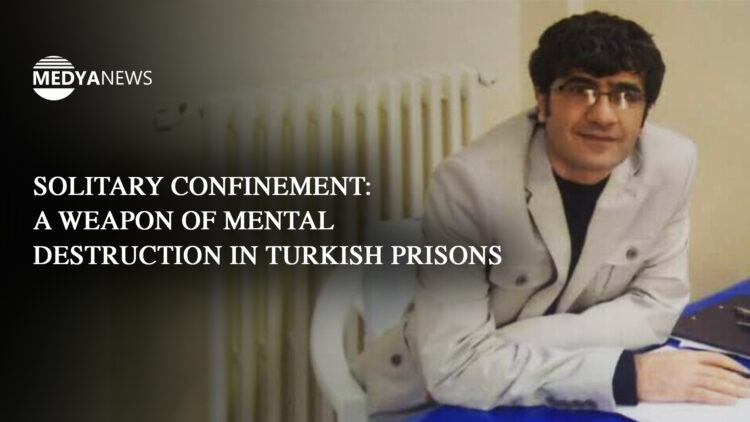
Zeki Bayhan, a political prisoner who has been incarcerated for 27 years in Turkey, has penned a powerful and deeply personal letter discussing the profound psychological and emotional impact of solitary confinement. Bayhan, currently held in Buca Kırıklar F-Type Closed Prison, originally addressed the letter to Kurdish leader Abdullah Öcalan, who himself is enduring isolation in İmralı F-Type High Security Prison. Although the letter was confiscated by the prison authorities, a copy has since been obtained by his lawyers and shared with the public.
During the most recent meeting of the Council of Europe’s Committee of Ministers, held from 17 to 19 September 2024, the CoE once again called on Turkey to reform its legal system regarding aggravated life sentences. The committee urged Turkey to introduce a mechanism for reviewing such sentences, citing the case of Abdullah Öcalan, who has been held in solitary confinement for over 25 years without any prospect of review.
This lack of a review mechanism violates the ‘Right to Hope’, a principle established by the European Court of Human Rights, the CoE highlighted. Despite repeated calls, Turkey has yet to implement the necessary reforms, prompting deep concern from the CoE and warnings of further action should no progress be made by September 2025.
In the letter, Bayhan reflects on the nature of solitary confinement, which he argues goes far beyond the physical separation of prisoners. He describes isolation as a systematic effort to imprison the human mind within the body, a process that pushes individuals towards self-destruction. He eloquently speaks of the struggles faced by prisoners, both in solitary and shared confinement, offering a series of “windows” into the harrowing reality of life under these conditions.
Below, we publish Zeki Bayhan’s letter in its entirety, unabridged, to bring to light his thoughts on the dehumanising effects of isolation, the importance of resistance, and the urgent need for solidarity with political prisoners enduring such conditions.
Zeki Bayhan’s Letter on Solitary Confinement
Hello,
I send my love and respect to you all, and I commend your sensitivity in addressing a social issue as hidden and isolated as solitary confinement under the oppressive political regime that has turned the country into a vast prison. I know that you too are not free, and I fear that if your awareness continues, your isolation might deepen. After all, in today’s world, anyone who isn’t in favour of the ruling powers could find themselves in prison at any moment. A young friend who was arrested a few years ago, after chanting slogans with dozens of others, said, “Oh, I feel freer here. If I had chanted these slogans outside, I’d have been arrested.”
I’m curious about the associations that the concept of solitary confinement creates in the minds of people outside. When I was asked to write something about it, my first thought was: what could I say? Not because there’s nothing to say, but on the contrary, there’s so much, and it’s so devastating. There’s so much that it’s hard to know where to begin or how to explain. And, of course, the doubt always lingers: how much will be understood? Because, when you think deeply about solitary confinement and its practices, it’s so inhumane that it falls outside the scope of normal human experience and perception. That’s why it’s not easy to comprehend.
Thus, I feel as though I’m speaking to you from a distant window. In reality, solitary confinement is to be without windows. In solitary confinement, all windows face inward. Into the self… It’s a kind of enforced self-destruction. It’s a terrifying form of torture that forces a person to only see, hear, and feel themselves everywhere they look. One feels like they are being pulled into a whirlpool, spinning and sinking, collapsing in on themselves.
Yes, solitary confinement has no window to the outside world, but a person who resists can find ways to create small holes in the walls of confinement. You know, when someone places their face against a tiny hole, that hole expands, and it becomes a window. I will try to open a few windows through which you can see the inside, the essence of solitary confinement. I know it’s hard to see the darkness inside from the light outside, but if you press your eyes close to these windows, maybe, just maybe, you’ll catch a glimpse… Now, let’s move to the windows…
Window 1: Solitary confinement is the physical isolation of a person within four walls. It’s usually analysed and critiqued within this framework. However, this is just the factual aspect of solitary confinement. The space, the architecture, is merely the area where solitary confinement is enacted; it is not the essence of it.
In reality, solitary confinement is not limited to locking someone between four walls. The real aim of solitary confinement is to imprison the mind within the body. This is the truly destructive part. Physical isolation, along with the control, surveillance technologies, and practices of the prison regime, all aim to achieve this. In solitary confinement, the prisoner’s entire focus, sensitivity, anxieties, and fears are directed towards themselves and their body. Once the prisoner falls into this trap, they begin to hollow themselves out, consuming themselves. Solitary confinement is the politics of pushing a person towards their own destruction by their own hand. Physical, ideological-political, psychological, but always destructive.
Window 2: From the most extreme to the relatively milder forms, the goal of solitary confinement is the same: to break a person psychologically, emotionally, and mentally.
Of course, it makes a difference whether a person is alone or with one or two others. Hearing a voice other than your own is comforting. However, in prolonged solitary conditions, even the people you share the space with lose their vitality and distinctiveness for one another, step by step. Constant proximity in a few square metres leads people to memorise each other’s every behaviour and reflex. And to the extent that those together lose their individuality for each other, they become parts of the solitary confinement system. Solitary confinement for one can become solitary confinement for three. And sometimes, solitary confinement for three can become even more challenging.
Window 3: Solitary confinement is a system of destruction that punishes a person with both isolation and the presence of others. Solitary confinement for one punishes a person with isolation. You yearn to hear a different voice. On the other hand, in confinement for three or five, you are punished by the presence of others. Can you imagine how terrible it is not to have a single moment to yourself for years and years?
When you’re upset, you can’t leave, when you’re overwhelmed by the people around you, you can’t retreat to a room and shut the door, and when you’re wracked with headaches, you can’t find a quiet corner to rest in. That’s what I’m talking about.
Window 4: Life in solitary confinement is based on endless repetition. Every day is the same as the last. Imagine living the same day for ten, twenty, or thirty years. You feel like you’re suspended in time, sensing that your perception of time has been erased.
A small social experiment: ask someone who has served a year in the military or attended university for a year about their memories. They’ll tell you long stories. Now ask someone who’s spent twenty or thirty years in prison… They’ll be more silent. Because, for twenty or thirty years, they’ve been living the same day.
Window 5: A life based on endless repetition gradually replaces thought with habit. Living the same day repeatedly makes it unnecessary for people to reconsider their actions. Habit arises from thought. But once the mind has thought about something and coded how it will be, what follows is endless repetition.
In solitary confinement, habits mechanise life to such a degree that, most of the time, actions are performed without thinking. Sometimes, a thought crosses the mind: “Did I do this?” You turn and look, and yes, you did it—without thinking.
People in prison seem like they think a lot. But this isn’t usually real, analytical thinking. It’s more like drifting between fragmented pieces of melancholy.
As I mentioned, solitary confinement imprisons the mind within the body. The network that imprisons the mind is habits.
Window 6: It’s misleading to think about solitary confinement only in terms of individual practices. Solitary confinement is a system, a set of practices. Individual practices gain meaning within this context. Therefore, the perception of these practices by prisoners may not match the perception of outsiders. Often, it doesn’t.
For instance, roll call is conducted twice a day. Prisoners are counted. The state says, “I have to count them for security reasons.” An outsider might say, “That’s understandable, it’s harmless.”
But for the prisoner, roll call is a reminder twice a day that they are nothing more than inventory, an exercise that keeps the awareness of nothingness alive.
Let’s think: is the outsider’s perception of this practice closer to that of the state or to that of the confined?
I also bring to your attention how necessary it is for security to physically count prisoners who are already under constant surveillance by every technological means for 24 hours a day.
Window 7: Solitary confinement also damages the psychology of the guards. It’s impossible for the enforcers of inhumane practices to remain normal. People gradually become “guard-like.”
The system knows this too. That’s why the guards who deal with lawyers and families coming from outside are generally different from those who deal with prisoners inside. A prison has an inside-facing and an outside-facing side.
These windows aren’t ones that bring light; rather, they are windows that carry darkness outside. That’s why it may have felt overwhelming. I was only just beginning, but I’ll stop here.
I’d like to end by saying a few things about the other side of the coin. Yes, solitary confinement is deep darkness. It encircles a person with countless nets. Slowly but surely, an endless sense of nothingness captures the mind and emotions. Yet, despite all this, it is possible to resist.
Resisting solitary confinement is difficult; you have to catch the light in the darkness and nurture it. Political prisoners succeed in this. Resistance takes many forms. For example, a political prisoner who has been in solitary confinement for ten or twenty years writing a current, publishable political article is an immense feat. Of course, the intellectual content of the writing is important, but even more significant and valuable is that, despite having been in solitary confinement for years, they remain engaged with the struggle of the people and can still speak about current politics. This is an example of resistance, showing that solitary confinement can be overcome with human willpower.
Political prisoners, even in prison or solitary confinement, are political subjects who continue to fight. The point at which the political prisoner shifts from being a political subject to being a victim because of their imprisonment or solitary confinement is where destruction begins. This is a trap. It’s been set deliberately. Unfortunately, some of us fall into this trap. When political prisoners are cut off from their political identity and struggle, what remains is the victim. And that is the aim of the solitary confinement regime.
The prison and solitary confinement regime can only be changed with a change in the political system. This is a long struggle and will take time. That means solitary confinement won’t be abolished immediately. In the meantime, small touches, small contributions to the lives and resistance of political prisoners in solitary confinement could be considered. It must not be forgotten that a person in solitary confinement needs human contact the most, and it’s not a matter of material support.
Here are a couple of small examples or suggestions:
Those who experience the harshest form of solitary confinement are political prisoners serving aggravated life sentences. In my prison, there are nine of us; in the three prisons on this campus, there are around twenty. If each patriotic, revolutionary, and democratic lawyer took on the power of attorney for one of these friends and held just a one-hour meeting every three months, it could give them a breath of fresh air.
Similarly, if any concerned individuals who are not lawyers could become pen pals with one of these friends, or send a couple of books every few months, it would offer some relief.
Are such gestures really so difficult? I leave it to your judgement. I’ve made my suggestions.
We must begin the struggle from the darkest part of solitary confinement. Let’s not forget it!
Solitary confinement may be cold, but the spirit of resistance is warm. I greet you all with warmth, love and respect drawn from the warmth of those who resist…


