

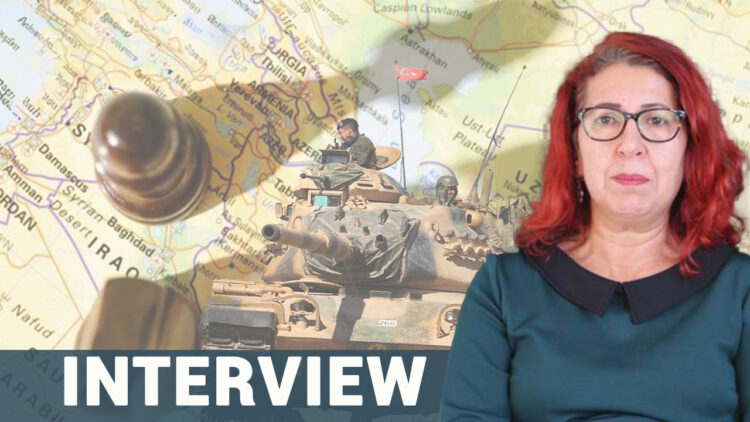
Turkey is looking to expand its influence in Iraq while retreating from Syria as part of a strategic shift in its regional policy, Middle East expert Hamide Yiğit* said in an interview with Mezopotamya Agency’s Esra Solin Dal on Friday. According to Yiğit, Turkey’s withdrawal from Syria is linked to efforts to secure new footholds in Iraq, marking a significant change in the dynamics of the region.
Yiğit highlighted Turkey’s changing approach in the Middle East, noting that “Turkey is now looking to create space for itself in Iraq in exchange for pulling out of Syria.” This, she explained, may involve Turkey shifting support to allied groups in Iraq, in a similar fashion to its backing of Syrian opposition groups.
The regional landscape has shifted dramatically since Hamas’ attack on Israel on 7 October 2023, leading to renewed focus on power balances in the Middle East. Yiğit explained that Israel’s conflict with Hamas has drawn in multiple regional actors, with Iran, Hezbollah and other groups siding against Israel, while many western and Arab states remain passive or support Israeli actions.
Yiğit also commented on Turkey’s evolving relationship with regional powers, noting that President Recep Tayyip Erdoğan’s government has moved away from aggressive foreign policy tactics in recent years, particularly in its dealings with countries like Egypt. She explained that the ruling Justice and Development Party’s (AKP) past support for the Muslim Brotherhood has become a liability, forcing Turkey to make concessions to Egypt, including limiting the activities of Egyptian Muslim Brotherhood supporters in Istanbul.
Turkey’s broader geopolitical manoeuvres, especially its military and economic collaborations in Africa and Somalia, reflect a shift towards more pragmatic, calculated alliances. “This shift is not driven by a desire for friendship, but out of necessity,” Yiğit said, pointing out the failure of Turkey’s previous expansionist policies in the region.
As Turkey repositions itself, its withdrawal from Syria may be contingent on the removal of Iranian militias from the country, a condition reportedly supported by Israel. This withdrawal, if realised, could mark a significant development in Turkey’s foreign policy, with potential repercussions for the wider region.
Turkey’s ambition to maintain influence through its allies in Iraq and Syria, such as the Syrian National Army (SNA), underscores the delicate balance the country is trying to strike. “Turkey seeks to secure a space for the SNA, a group it initially backed to fight the Syrian regime, but which now fights primarily against Kurdish forces,” Yiğit said. This strategy highlights the complex network of alliances Turkey has fostered over the years, as it navigates shifting alliances and regional conflicts.
Yiğit concluded that Turkey’s continued reliance on military interventions, especially in Iraq, reflects internal political pressures, noting that “whenever the government faces domestic challenges, it turns to military operations against the Kurds as a way to shift attention.”
(*) Hamide Yiğit, a Middle East expert and writer, has extensively focused on the Syrian conflict and broader regional dynamics since 2011. Her work critically examines imperialist interventions in the Middle East, with a particular emphasis on Syria. Yiğit’s first major piece, “Suriye Gerçeği: Savaş kapımızda, duyan var mı” (The Truth About Syria: War at Our Doorstep), highlighted the impending crisis, and she has since published numerous articles on the subject. Additionally, she has translated works from Arabic related to Syria and Egypt, contributing to various publications and providing in-depth analysis on regional conflicts and political developments.


