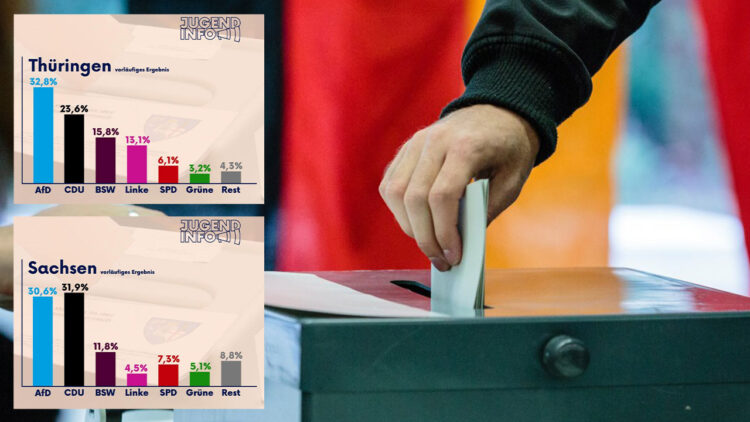
The far-right Alternative for Germany (AfD) and the left-wing populist Sahra Wagenknecht Alliance (BSW) have made significant gains in the Germany’s state elections. Die Linke and the parties in the governing coalition under Olaf Scholz of the Social Democratic Party (SPD) have suffered historic losses.
For the first time since World War II, a far-right party has won a state election in Germany, with the AfD receiving 32.8% in the federal state of Thuringia. The conservative Christian Democratic Union (CDU) fell to second place in popularity in the state, polling at 23.6%. Die Linke suffered historic losses, losing almost 18% compared to the previous state elections in 2019.
The AfD also achieved 30.6% in Saxony, where the CDU narrowly won with 31.9%. The months-old BSW, which emerged from Die Linke and, like the AfD, demands sharper controls on immigration and an end to arming Ukraine, came third in both states, though it significantly underperformed earlier polls.
In June’s European Parliament elections, the AfD scored a record 15.9% overall and did especially well in eastern Germany, where it emerged as the largest party.
The elections are seen as a historic defeat and a clear message of disfavour towards the Green Party, the SPD and the liberal Free Democratic Party (FDP), which make up the governing coalition. The future government of Germany will be elected in the next national election, due in 2025.
While AfD leaders have stated that they will be part of the future government in both federal states, other parties have ruled out joining a coalition with the AfD. The inconclusive results mean that forming a government is expected to be difficult.
The election results were met with spontaneous protests in several German cities, with thousands of people taking to the streets to demonstrate against the shift to the far right.