

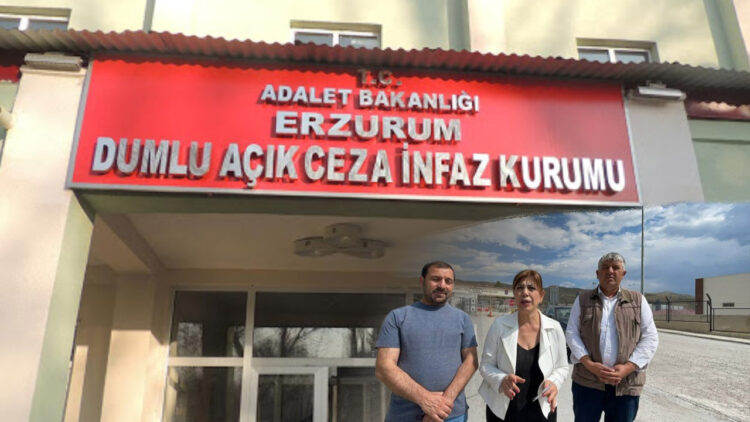
Meral Danış Beştaş, a Member of Parliament from the pro-Kurdish Peoples’ Equality and Democracy (DEM) Party representing Erzurum (Erzirom), visited the Dumlu 1 and 2 High-Security Prisons in eastern Turkey on Monday, where she raised serious concerns about the harsh solitary confinement measures and deteriorating health conditions faced by prisoners. Her visit comes amid increasing reports of human rights violations at the facility.
Following her visit, Beştaş held a press conference outside the prison, where she detailed the severe conditions experienced by seven inmates she spoke with. “This prison is no different from the notorious S-type facilities. It is one of the worst in terms of human rights violations. We have seen once again that solitary confinement is spreading throughout all prisons, not just at İmralı Island Prison,” Beştaş stated.
Beştaş explained that inmates are subjected to severe restrictions, including limited access to fresh air. “The prison’s open-air time is restricted to just one or two hours per day. Inmates are moved to a separate area for this, where they are subjected to searches. Despite their right to more outdoor time, they are confined to just two hours daily,” she said.
She expressed deep concern about the health of some inmates, describing the conditions as inhumane. Beştaş highlighted the case of Halil İrmez, a former provincial co-chair of the Kurdish Peace and Democracy Party (BDP), who has been held in solitary confinement without access to fresh air for over a year and a half. “We will make the necessary appeals to the Ministry of Justice. This situation is totally unacceptable. Prisoners serving aggravated sentences are subjected to severe solitary confinement, similar to the conditions faced by Mr Öcalan and other inmates in İmralı Prison,” said Beştaş. Abdullah Ocalan, the leader of the Kurdistan Workers’ Party (PKK), has been held in solitary confinement in İmralı Prison for 25 years and has had no contact with his family or lawyers for the last 3.5 years.
Beştaş also highlighted the plight of seriously ill prisoners, including İmdat Bingöl, who has been imprisoned for 28 years and suffers from chronic obstructive pulmonary disease (COPD) and kidney problems. She also mentioned Naci Özer, who has epilepsy, and Mahmut Okay, who is paralyzed. “We will ensure that these issues are brought to the forefront,” Beştaş vowed.


