

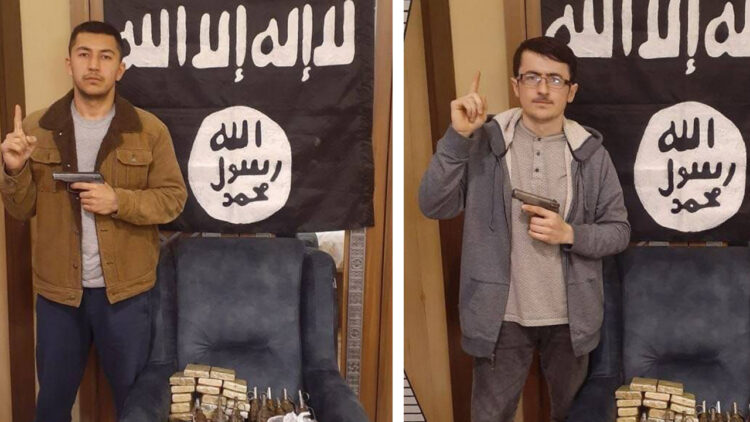
An indictment prepared by Istanbul’s Chief Public Prosecutor’s Office has presented evidence that at least two ISIS attacks were carried out by a Tajik militant codenamed ‘Culaybi’. Culaybi travelled from the Turkish city of Izmit, in Kocaeli district, to carry out the attacks in Pakistan and Afghanistan.
Hale Gönültaş, writing for Turkish left-wing newspaper Artı Gerçek pointed out that the indictment only mentions Culaybi’s responsibilty for an attack on a Shiite mosque in Pakistan in March 2022. But an ISIS training video disclosed as part of the evidence in the indictment indicates that Culaybi was also involved in the 12 December 2022 attack on a hotel in Kabul, Afghanistan.
Gönültaş released a detailed report last year analysing Turkey’s position as a strategic logistical hub for the organisation, and providing a key staging post for the recruitment and training of members and planning of attacks. The recent revelations about Culaybi give further weight to this analysis.
Court evades scrutiny of ISIS Khoresan Turkey
In the same indictment, Istanbul 28th High Criminal Court heard evidence on 24 July against Abdulmusair Gulboev, who was allegedly the leader of ISIS Khorasan Turkey. Gulboev, another Tajik national, was accused of ‘leading a terrorist organisation’, however the court found him guilty of the less serious charge of ‘membership’.
Commentators have surmised that the court decision was strategically taken to confine the case against Gulboev to membership of ISIS in Afghanistan and thus avoid scrutiny of the operations of ISIS Khoresan Turkey.
ISIS Khorasan Turkey’s involvement in the Kabul bombing
Three people were killed in the Kabul hotel attack, and 18 injured. Most of the people in the hotel were Chinese business people. ISIS Khorasan later released a statement saying that the attack was a response to the Chinese state’s oppression of the Uyghur people, a Muslim minority within China.
Evidence served in the indictment shows that the administrator of a closed ISIS communications channel posted a video describing the tactics used in the Kabul attack. Culaybi, alongside another ISIS member, appeared in the video beneath the ISIS Khorasan coat of arms.
The Taliban administration announced soon after the bombing that the two attackers had been killed. However, ISIS itself claims that it does not know whether Culaybi and his accomplice are alive or dead.
Gönültaş recognised Culaybi from a previous indictment presented against the ISIS Khorasan Turkey group. That indictment was accepted by the Istanbul Chief Public Prosecutor’s Office in November last year.
Moscow attacker travelled from Turkey too
Fariduni Shamsidin, one of four suspects in the March 2024 Moscow concert hall bombing that killed 137 people, travelled through Turkey on his way to Russia. Shamsidin’s Instagram account showed that the 25-year-old man from Tajikistan had been in Istanbul’s Fatih Mosque just days before the Moscow attack.
After the Moscow bombing, the Kurdistan Communities Union (KCK) accused the Turkish government under President Recep Tayyip Erdoğan of orchestrating and directing ISIS as a weapon against its opponents, including the Kurdish people and the Kurdish liberation movement in Syria, Iraq and Europe.
Furthermore, in January 2024, ISIS carried out twin bombings in the Iranian city of Kerman. The Kurdistan Strategic Research Centre (lekolin.org) pointed to “reliable sources” that one of the bombers received training in Turkey in 2017.
The Turkish state has been accused of longstanding support for ISIS, and of the instrumentalisation of the terror group in carrying out actions which support Turkish foreign and domestic policy. In March, the KCK wrote that “With ISIS, the AKP-MHP regime threatens everyone and uses this as leverage to get concessions,” The KCK sees this support for ISIS as part of the implementation of an imperialist “neo-Ottoman ideology”.
“As the Kurdish Freedom Movement, we have fought against the barbarism and fascism of ISIS,” wrote the KCK at the time.


