

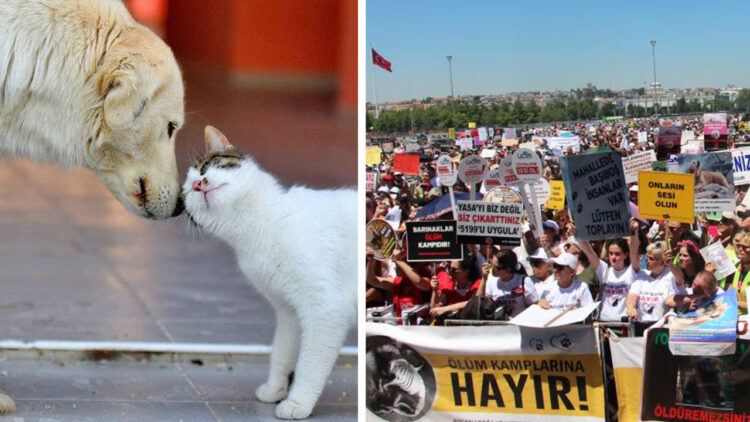
The Turkish parliament is debating controversial amendments to the Animal Protection Law, raising concerns about the welfare of stray animals, particularly dogs.
The Agriculture, Forestry and Rural Affairs Committee of the Turkish Grand National Assembly discussed the proposed changes on 22 July, amid protests from animal rights activists who were barred from attending the session.
While Western countries have traditionally focused on removing strays from public spaces for shelter placement or adoption, Turkey embraces a unique approach of coexistence. The approach aims to foster harmony between humans and animals in shared urban environments, reflecting a more inclusive societal attitude.
Harun Mertoğlu, an MP from the ruling Justice and Development Party (AKP) and the bill’s primary sponsor, announced the removal of the term “euthanasia” from the draft following criticism. However, the bill still references Article 9 of the Veterinary Services, Plant Health, Food and Feed Law, which permits euthanasia under certain conditions.
“The amendment allows for euthanasia of dogs deemed dangerous to human and animal life and health, those with uncontrollable negative behaviours, contagious or incurable diseases, or those prohibited from adoption,” Mertoğlu explained.
Critics argue the bill’s language remains vague and could lead to mass euthanasia of stray dogs. Saliha Sera Kadıgil, Istanbul MP for the Workers’ Party of Turkey (TİP), voiced concerns about the bill’s broad scope. “While it’s said to target stray dogs, the term ‘stray animals’ could potentially include cats,” she warned.
During a press conference on Monday, pro-Kurdish Peoples’ Equality and Democracy (DEM) Party spokeswoman Gülistan Kılıç Koçyiğit also expressed strong opposition to the proposed law concerning stray animals, which would allow their killing. She criticised the legislation as inhumane and misdirected, urging that it reflects broader issues with the current government’s priorities.
The proposed legislation grants local authorities increased power to manage stray animal populations. It mandates that collected animals be taken to shelters rather than returned to their original locations, a move that has alarmed animal welfare advocates.
Tensions rose as animal rights defenders were denied entry to both the committee room and the corridor outside. Some protesters expressed dissent through applause and chants.
Opposition MPs criticised the exclusion of key stakeholders from the discussions. They called for the participation of representatives from the Veterinary Association and the Animal Rights Commission of the Turkish Bar Association.
Turkey’s stray animal crisis: key points shaping the debate
1. Cultural Differences: Western Isolation vs. Turkish Integration
– Attitudes toward stray animals sharply contrast between Turkey and Europe.
– Western countries focus on removing strays from public spaces for shelter placement or adoption.
– Turkey embraces a unique approach of coexistence: integrating strays into communities, providing essential care like neutering and vaccinations.
2. Legal Framework vs. Implementation:
– Law 5199 mandates municipalities to manage stray animals humanely through sterilisation, vaccination, and rehabilitation.
– However, there’s a significant gap between legal requirements and actual implementation.
– Many municipalities are failing to fulfil their duties, leading to poor shelter conditions and inadequate animal care.
3. Political Context:
– President Erdoğan’s recent statement advocating for housing strays in shelters contradicts the existing law.
– This shift in policy might be seen as an attempt to address public concerns, but it doesn’t align with the established legal framework.
– The Turkish government is criticised for attempting to shift the public’s focus away from more pressing issues such as poverty, inflation and systemic governance failures.
4. Shelter Conditions:
– Reports indicate that many animal shelters in Turkey are in deplorable conditions.
– Issues include overcrowding, poor hygiene and inadequate medical care.
– Some shelters have been described as ‘death camps’, highlighting the severity of the problem.
5. Legislative Changes and Consequences:
– The ’14 January Law’ of 2021 shifted responsibilities for sterilisation to private clinics.
– This change has led to increased pet abandonment due to financial strain on owners.
– Municipal shelters are ill-equipped to handle the resulting increase in stray animals.
6. Systemic Failures:
– The core issue is a systemic failure in addressing the root causes of stray animal populations.
– Lack of effective sterilisation policies and poor enforcement of existing laws contribute to the problem.
7. Advocacy and Criticism:
– Animal rights advocates and legal experts argue for better enforcement of existing laws rather than new restrictive measures.
– They emphasise the need for widespread sterilisation and improved shelter management.
8. Potential Solutions:
– Stricter enforcement of existing laws on municipal responsibilities.
– Improved funding and management of animal shelters.
– Implementation of comprehensive sterilisation programmes.
– Public education on responsible pet ownership and animal welfare.


