

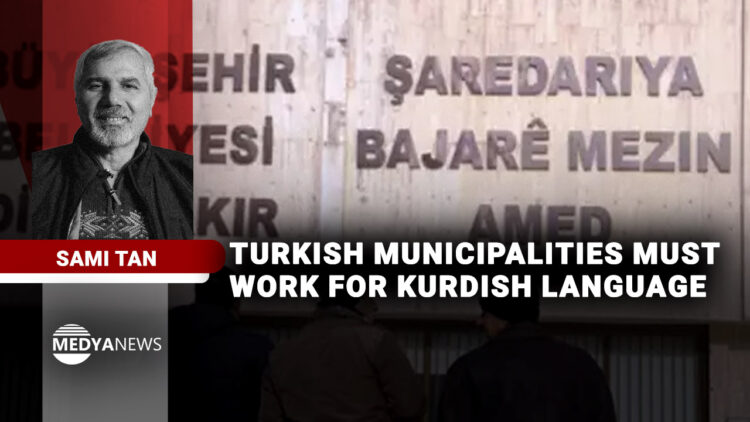
Sami Tan
Four months have passed since [Turkey’s] regional elections. The municipalities that came under Kurdish control began their work despite facing some attacks and obstacles. I strongly condemn the takeover of the Colemêrg (Hakkari) municipality, and express my support for the detained mayor and the elected municipal council. As representatives of the Kurdish Culture and Language Committee in Riha (Şanlıurfa), we visited the municipalities of Curnê Reş (Hilvan), Hewag (Bozova), Wêranşar (Viranşehir), Kaniya Xezalan (Akçakale), and Xelfetî (Halfetî). In the coming days, we will also visit the Pirsûs (Suruç) municipality. We declared our support and readiness to develop Kurdish cultural and linguistic work. The mayors expressed their desire to work in this field. We hope that work will shortly begin for the development of the Kurdish culture and language.
Language develops primarily in the speech of the people, alongside the development of their thoughts, feelings, and emotions. Language, like people, needs a free environment to thrive. As such then all languages should be allowed to flourish at the same level. If a language interacts freely with other languages, it should be able to show its strength and richness at all levels, without being hindered in its development. Hence, a primary language needs [recognized] status and should be well received in the hearts of its speakers, making its speakers proud and honourable. Unfortunately, Kurdish people in North Kurdistan (Kurdish majority regions in southeast Turkey) are deprived of these opportunities.
It is true that the issue of a language’s status is not in the hands of local and regional governance. Therefore, a continuous political struggle is necessary.
Nonetheless, municipalities can take steps to elevate the prestige of a language. Primarily, they can ensure all their work is done in Kurdish, making Kurdish a de facto official language. To this end, a centralised language policy and planning are needed. Party-led local municipalities should have a clear and strong stance as to how their language can be protected and advanced. They should write their plans gradually according to their language policy, and ensure control across all levels of the regional authority.
For the development of cultural and linguistic projects at a central level, there must be a clear programme. According to this programme, a special department should be established within municipalities. In other words, offices should be established in metropolitan cities, towns, and districts for Kurdish culture and language. Of course, the issue of preserving and developing a language is not solely the task of one department. First, the staff of this department, and then all municipal employees, should be trained in the Kurdish language. It is not enough to only know the regional language; employees must learn the [formal] written language and be pioneers in this regard.
The fate and destiny of a language are determined by the attitude of its speakers. However, unfortunately then a significant portion of Kurdish society is indifferent to the preservation and development of Kurdish. Many families, without being pressured, raise their children in the dominant language [Turkish]. This approach is alarming for the future of the Kurdish language. Therefore, in contradistinction to this mentality of linguistic extermination, a strong effort for the preservation and development of the Kurdish language is necessary. Alongside institutions and enthusiasts of the Kurdish language, municipalities can undertake a comprehensive and coordinated effort.
As always, the field of standardisation and unification of language is a strategic area for education and training. This particularly means education and training for children. Just as the municipality of the metropolitan city of Istanbul opened many nurseries and primary schools in many districts, Kurdish municipalities can open Kurdish primary schools in every district. In this regard, media institutions and municipalities could prepare an educational programme in Kurdish, similar to Turkey’s Education Ministry’s Education Information Network (EBA) platform and broadcast it on a television channel.
In this regard, Kurdish municipalities are not inexperienced, as many activities were already undertaken before they were taken over. For instance, in Amed (Diyarbakır), there were two academic institutions in the field of Kurdish music, theatre, and literature. Similarly, many primary schools for children were opened in various cities. Again, music and theatre activities were predominantly in Kurdish. Social media activities and municipal information dissemination were multilingual.
Besides these, many educational centres were opened in several districts, where young people were prepared for university exams and learned Kurdish. Additionally Kurdish, festivals, conferences, language workshops and book fairs were organised. All these activities, along with some new projectss, should be systematically organised and carried out with a more appealing, civil and democratic approach.


