

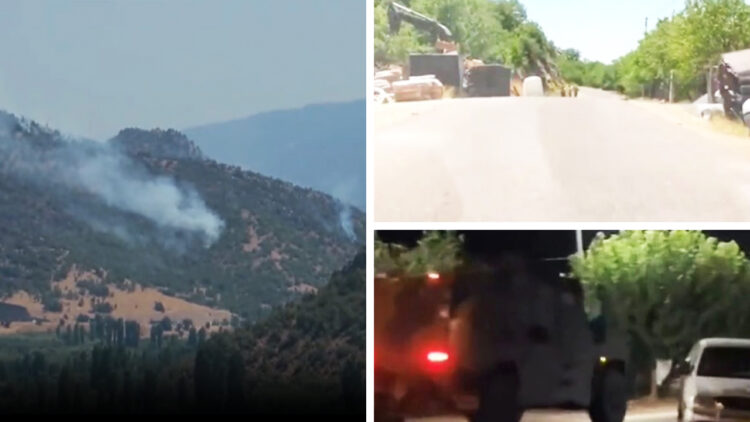
The Turkish state’s military incursion into Iraqi Kurdistan continues unabated, with significant military movements observed in the region. With the cooperation of the Kurdistan Democratic Party (KDP), Turkish forces have been deploying soldiers and armoured vehicles into the Kurdistan Region of Iraq (KRI). Reports from last night indicate a surge in military activity, with an unidentified Turkish aerial vehicle downed.
The ongoing Turkish offensive, aimed at establishing control in the area, has resulted in persistent military deployments and attacks. A convoy of Turkish armoured vehicles and heavy weaponry passed through the village of Guherzê in the Amêdi (Amêdiyê) district of Dohuk governorate. Rojnews footage revealed an unidentified Turkish aerial vehicle being downed, though it remains unclear whether it was a helicopter or a drone.
The Kurdistan Workers’ Party (PKK) fighters continue to defend Iraqi Kurdistan with steadfast determination against the occupiers.
Journalist Altan: Turkey begins annexation
Journalist Erdoğan Altan has reported that Turkey has initiated the annexation of several areas within the Kurdistan Region, displacing local populations and replacing them with paramilitary groups. These actions are perceived as an attempt to alter the region’s demographics.
Recent Turkish attacks have intensified in the rural areas of Amêdi. Establishing control points and conducting identity checks, Turkey frequently bombs village centres and rural areas by land and air. Over 800 paramilitary fighters have reportedly been relocated from Syria and deployed in the region.
ISIS militants deployed
Altan highlighted Turkey’s efforts to create a buffer zone against the PKK, describing these actions as an “annexation attempt”. He claimed that some of the paramilitary groups include ISIS militants. Villages have been evacuated, and a wave of arrests and detentions has commenced. Altan indicated that Turkey and the KDP have jointly facilitated the settlement of these radical groups, effectively turning Iraqi Kurdistan into a new haven for extremists. He suggested that Baghdad’s inaction might imply tacit approval or secret agreements.
Buffer zone ambitions
Turkey’s control points, identity checks, and village evacuations have raised questions about the legitimacy of current administrations. Altan voiced concerns over the settlement of radical groups in evacuated areas, including ISIS members, aiming to alter the demographic structure. He explained that Turkey plans to establish a buffer zone stretching from Dohuk to Erbil (Hewlêr), encompassing multiple towns and villages, similar to the strategy in North and East Syria.
Paramilitary commanders identified
Altan disclosed details about commanders of the paramilitary groups, including individuals with histories of involvement in extremist organisations in Syria. These groups have been stationed at 72 checkpoints and bases, underscoring their role as Turkey’s local power in the region.
Evacuations and future threats
The latest attacks have led to the evacuation of 162 villages, with threats looming over 602 more. Reports suggest financial incentives are being offered to families to relocate to camps in Erbil and Dohuk. Altan warned that these actions could provoke significant unrest, though the KDP appears to be attempting to normalise the situation.
Since mid-June, Turkey’s military operations in the KRI have escalated, targeting civilian areas and establishing new bases. The Turkish military’s deep penetration into Iraqi territory has drawn criticism for the lack of response from both the Iraqi federal government and the Kurdistan Regional Government (KRG).
In light of these developments, Sepi Media recently exposed the identities of 416 former ISIS members allegedly trained by Turkish forces, raising significant concerns about Turkey’s military strategy and its potential impact on regional stability. This revelation could prompt increased international scrutiny and ethical questions regarding the use of former extremists in ongoing conflicts.
Experts believe that Turkey’s actions will influence the region’s upcoming elections, scheduled for 20 October, potentially extending Turkish control over Dohuk and delaying the electoral process.


