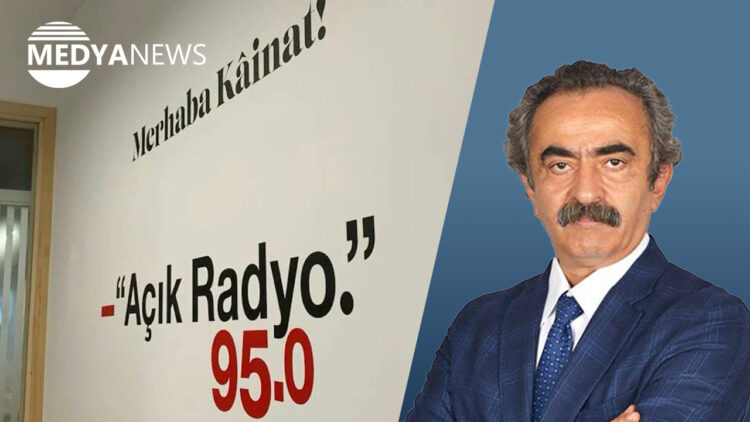
Ali Duran Topuz
The pretext fabricated to shut down Açık Radyo is the same accusation that was used at the beginning of the trial that led to the death of Hrant Dink. The Radio and Television Supreme Council (RTÜK) combines hatred of Armenians with hostility towards freedom, resulting in the slandering of Açık Radyo.
Açık Radyo is such a wonderful station! But it is being shut down with an ugly slander. The allegation is that Açık Radyo violated the following legal provision:
(A broadcast under the supervision of RTÜK) “shall not incite society to hatred and enmity by discriminating on the basis of race, language, religion, gender, class, region and sect, or create feelings of hatred in society”.
These are slanders, outright slanders. We are really talking about a radio station that is “open to all the sounds of the universe”, a station that has managed to produce a quality that is rare not only in Turkey but worldwide. Unfortunately, there is a history of using the law to slander, which I’ll come back to later, but first let’s specify the reason for the accusation. A guest on an Açık Radyo programme mentioned “the Genocide” in relation to 1915. In other words, they spoke about the Armenian genocide.
Absurd but serious
One is tempted to say, if you are looking for an excuse to punish Açık Radyo, we can help, but please don’t resort to such ugly slanders: Finding evidence of “incitement to hatred and enmity” on Açık Radyo, or even the possibility of “discrimination on grounds of race, language, religion, gender, class, region and sect” is absurd. Were it not for the temporary closure decision and the threat of permanent closure, we could laugh, but the situation is very serious, embarrassingly serious.
But wait a minute, we recognise this phrase “incitement to hatred and enmity” from somewhere. Isn’t this a version of an article in the penal code that the RTÜK has adapted? Isn’t this the same charge on which Hrant Dink was tried? The same charge that made Dink the target of the hate campaigns that led to his assassination? So the same slander that was used against Hrant Dink is now being used against Açık Radyo. If the accusation was serious enough to warrant a murder, the radio station would be closed down! We call it slander, but don’t those who initiated the case against Dink and those who made the decision to close Açık Radyo know this? Of course they do! But there is a history that makes this slander possible, which I will also come back to below.
What a murderer doesn’t do to a radio station!
Just as it was absurd to claim that Hrant Dink had violated the Turkish Penal Code (formerly Article 301, now Article 216), it is equally absurd to claim that Açık Radyo had violated the aforementioned RTÜK article. The campaign of attacks against Dink and the “closure” procedure against Açık Radyo are based on the same illogical premise:
The illogicality of overturning an article of the law in order to fabricate a non-existent accusation.
Hrant Dink believed that recognition of the Armenian genocide would serve as a form of healing for Turkish society, allowing Armenians to process their pain and grief and Turks to face the truth and take responsibility. The article for which he was prosecuted criticised certain attitudes within the Armenian community, but the case was not brought because he “criticised Armenians”; it was brought to silence someone who said “genocide”. Saying “genocide” was a crime serious enough to lead to his murder. First the court opened the case, then he faced racist attacks accompanied by the “grey wolf” sign, and even that was not enough, so the police, informers, gendarmerie and intelligence officers all worked together to kill Dink. Let’s not forget: the racist, inciting media was active at every stage. So, what would those who kill people/have people killed not do with the radio?
Is it a crime to say ‘genocide’?
So what is this “Armenian” issue? Is it a crime to say “genocide”? What kind of discrimination occurs when someone says genocide? How does it incite hatred and enmity? What kind of hatred is created?
There is no article that criminalises saying “genocide”. If a citizen uses this term for 1915 or any other massacre (for example, I consider Dersim 1937-38 a genocide), there is no article in the law to prosecute them. You can’t manufacture a crime out of nothing or out of RTÜK. You can’t make a crime out of interpretation. You can’t present something that is not a crime as if it were a crime.
Saying that Armenians were subjected to genocide does not have the potential to incite “hatred and enmity”. Who would be provoked by an expression of victimhood? But of course, hatred, hostility and feelings of enmity play a very crucial role in this game, which I will come to.
The real crime: hostility to Armenians
The relevant articles of the Turkish Penal Code (TCK) and the RTÜK are not really meant to punish Hrant Dink or Açık Radyo, but rather to protect the diversity they represent, address or are part of. So the attempt to close down Açık Radyo is itself a violation of this article!
However, those who enforce the laws are using these articles like torches to incite society and are themselves committing the real crime. How is this possible? How can an article of the law be so thoroughly subverted? And how can so few people notice the trickery? The thing that makes it possible is hatred and hostility, especially hostility to Armenians. And hatred of Armenians. This hatred and hostility will apparently not end until the last Armenian dies. It is a hostility that is so pervasive that it doesn’t seem to end even when there is no one left to say “Armenian”. Açık Radyo is being closed down precisely because it does not participate in hostility to Armenians, does not allow it and does not commit the crime of denial. RTÜK says: “Forget the voices of the universe, just be open to the voice of the state”.
This enmity needs a name
It is an enmity as poisonous as the anti-Semitism that led to the establishment of the Holocaust ovens, but for some reason it does not have a special name, whereas it is so advanced that it deserves a special name. It is an enmity that has penetrated all the institutions and laws of the Republic of Turkey and has penetrated deep into the psyche of those who run, operate and implement those institutions and laws; an enmity that is so ingrained in the state it always finds a response in the society, especially when we consider the confiscated movable and immovable property in 1915, i.e. the forbidden morsels or the cursed shares, this is a model of enmity that is hand in hand between the society and the state. When such a ready-made enmity is combined with an understanding of governance that is orientated towards silencing everyone, imprisoning those who do not, in short, establishing a dictatorship, we should not be surprised if TRT (Turkish Radio Television) is shut down tomorrow. In short, RTÜK wants to destroy Açık Radyo by combining hatred of Armenians and hostility towards freedom.
The most fundamental characteristic of this model of enmity is that it understands and communicates everything in reverse. In fact, we are at the roots of a form of lawlessness that I call “anti-law”, which was shaped in the Kurdish laboratory and originated in 1915. The trial against Hrant Dink (under the old TCK 301, now 216) and the punishment against Açık Radyo (under Article 8/1 of Law 6112) basically say this: You will not mention the Armenian question. Whether you are Armenian or not. Otherwise, we will silence you. If RTÜK is enough, through RTÜK. If not, with Ogün Samast – there are enough killers in our society.
Ali Duran Topuz, born in 1967 in Zara, Sivas, is a prominent journalist and writer. After studying law at Istanbul University and working briefly as a lawyer, he became a journalist in 1994. Topuz spent 17 years at Radikal newspaper, and was a founding editor and editor-in-chief of Gazete Duvar from 2016 to 2021. He is now a columnist for Artık Gerçek and has also published poems, stories and literary criticism in various magazines. He is known for his insightful commentary on the Kurdish issue, Alevis and other marginalised communities in Turkey. Follow him on Twitter.