

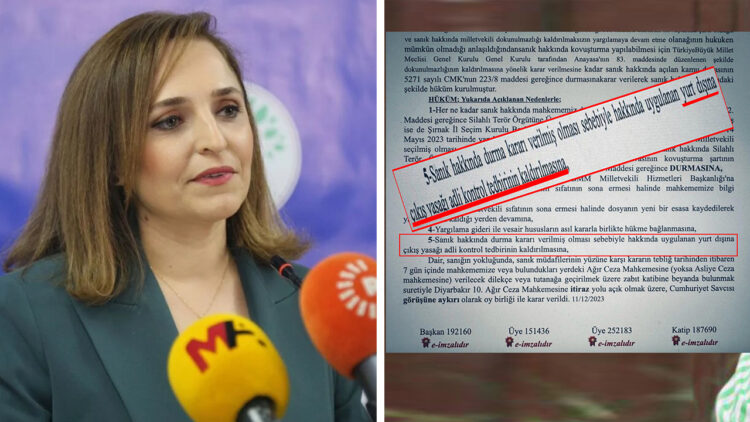
In a recent incident at Istanbul airport, Ayşegül Doğan, Spokesperson for the People’s Equality and Democracy Party (DEM) and Şırnak MP, was prevented from travelling to Paris for a meeting of the Parliamentary Assembly of the Council of Europe (PACE) on 2 June. Airport police informed Doğan just 10 minutes before her flight that she was banned from leaving the country on the basis of a 2020 ruling by the Diyarbakır 9th High Criminal Court.
Doğan’s travel ban had been lifted in December, following her election as an MP, in accordance with Article 83 of the Constitution on parliamentary immunity. Despite this, she was presented with the outdated 2020 ‘restriction’ decision.
“This was my first attempt to attend a PACE session since being elected. I arrived at the airport at 6pm and handed in my passport. Five minutes before the flight, three police officers approached me and told me that I had a travel ban. Despite explaining that the ban would be lifted in 2019, they did not allow me to continue. Tomorrow it will be reported that the main member could not attend the meeting due to the obstruction of three police officers. It’s as if we are experiencing cognitive dissonance. I believe that either an official forgot to update the system or my travel was deliberately obstructed, ” Doğan said, recounting the incident.
Journalist Fehim Işık pointed out that Doğan’s case was dropped and her travel ban lifted after she was elected as an MP for Şırnak. He noted how the court issued this decision in December last year and sent a copy to Parliament. Despite this, Doğan was still prevented from leaving the country at the airport.
“The authority behind this obstruction is unclear. Neither the Interior Ministry nor the Justice Ministry is taking responsibility. Everyone is passing the buck. This is what ‘normalisation’ towards the Kurds looks like – trustees in Hakkari, illegal obstacles for deputies, pressure on the people. We have to understand that these actions are not isolated incidents,” Işık said.
Ayşegül Doğan’s case highlights significant shortcomings in Turkey’s legal and bureaucratic systems. Despite her travel ban being lifted, she was blocked at the last moment, raising serious questions about the enforcement of legal decisions.
The incident is an example of the increasing obstruction of legal rulings in Turkey, where decisions by the Constitutional Court, the European Court of Human Rights and local courts are often either not implemented or effectively violated by the security forces.


