

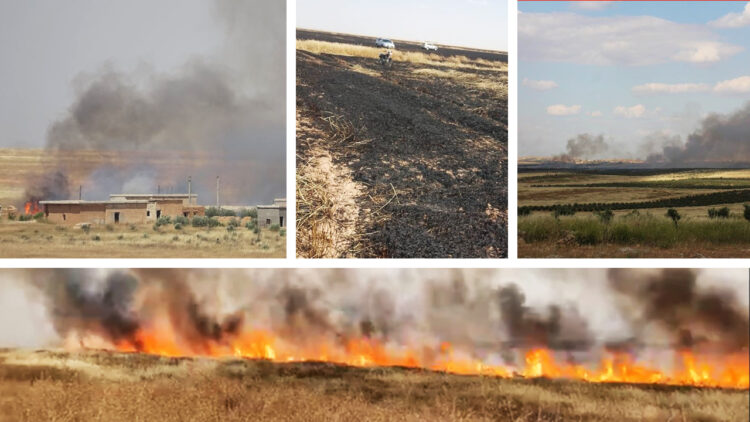
Agricultural lands in North and East Syria faced extensive damage due to fires and shelling by Turkish forces and their mercenaries throughout the weekend. The systematic shelling not only destroyed hundreds of hectares of crops but also significantly impacted civilian life in areas close to Turkish-occupied territories.
On 10 May, mercenaries affiliated to Turkey initiated fires devastating 200 hectares of agricultural land and approximately 3,000 olive trees near Manbij (Minbic). “Fire caught in our agricultural crops due to the Turkish bombing, starting from the village of Korhiyuk and spreading across several villages. Despite efforts with tractors and firefighting equipment, the flames, fanned by strong winds, destroyed olives, grapes, barley, wheat, and lentils,” reported Fatima al-Mohammad, a local farmer from the village of al-Kawkli, speaking to ANHA.
In addition to Manbij, the western countryside of Zirgan witnessed similar destruction on 9 May. Here, mercenaries set fires near the village of Rabi’at, directly targeting agricultural crops. The same tactics were employed near contact lines in the western countryside, in villages under Turkish occupation.
Further artillery shelling by Turkish forces targeted Khirbet Shaal in the canton of al-Shahba and Saydda, a village near Ain Issa. The shelling caused fires that reached residential areas, threatening lives and causing material damage. In Tel Kochar, an inferno of unknown origin destroyed 100 dunums of wheat and barley, although local fire brigades managed to extinguish the blaze with community assistance.
These incidents are viewed as part of a broader strategy by Turkey to undermine the region’s Kurdish self-administration by targeting food resources and forcing displacement.
Wafaa al-Ahmad, a resident from the village of Ilan, highlighted the broader impact on civilians. “The fires burned along the front-line villages due to the bombing and crop burning by the occupation forces and mercenaries, causing smoke to invade homes and leading to suffocation, especially among asthma patients,” he said.


