

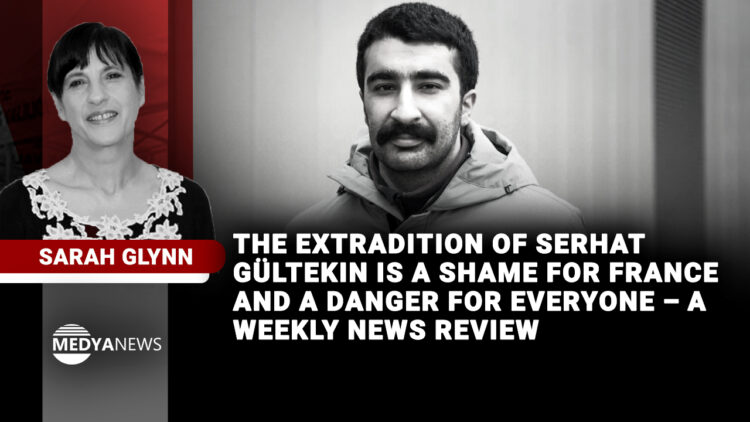
Sarah Glynn
In the words of Serhat Gültekin’s lawyer, his extradition by the French state has “opened the door” to new dangers. David Andic was in Strasbourg to alert members of the French delegation at the Council of Europe to the implications of his client’s case. The Council was established to protect human rights, democracy, and the rule of law, and Gültekin’s human rights have been eliminated in a gross denial of justice. This has caused alarm through the French Kurdish community, and ought to worry everyone here if they get to learn about it. I had the opportunity to sit down with Andic and talk about the case, and want to use this week’s review to set down what happened and why its importance extends even beyond the destruction of the man at its centre.
The authorities called Gültekin’s removal an expulsion or deportation, but in reality, it was an extradition because they knew without doubt that, on arrival in Turkey, he would be arrested and forced to serve his previous conviction that had been made under Turkey’s ever elastic “terrorism” laws.
French law does not allow deportation to a country where “your life or your freedom is threatened.” Extradition requests, for people suspected or convicted of an offence, have to be made via a different process from simple expulsions, and must not be granted if the offence is political. In either case, the law does not allow the person to be sent to a state where “there is a serious risk that he or she would be subjected to the death penalty, torture or other inhuman or degrading treatment or punishment.” The French authorities also knew, including from reports carried out by the Council of Europe,
that Gültekin’s chances of escaping such treatment in the Turkish prison system were next to non-existent.
From Turkey to France
But I will go back to the beginning. Serhat Gültekin was born at the end of 1996 and grew up in the city of Diyarbakir (Amed), which is regarded as the de facto capital of Northern (or Turkish) Kurdistan. In 2013, when he was sixteen, he began to be active with the pro-Kurdish leftist Peoples’ Democratic Party (HDP), and in 2014 and 2015 he helped the party with election preparations. In 2015 he started university in Istanbul. Already, the police had visited his home, and that December, after he had gone, with other HDP activists, to help the people of Cizre, he was arrested.
This was an especially turbulent period for the Kurds in Turkey. The year had begun with hopes that ongoing talks between the government and the PKK, mediated by the HDP, would usher in a new era of peace, but these hopes had been smashed as President Erdoğan denied first the tentative agreement that had been reached, and then the very existence of a Kurdish Question. Erdoğan could see that the talks were winning support for the HDP and not for his Justice and Development Party (AKP), and that the HDP would not countenance an anti-democratic bargain to give him the power he desired, and he was infuriated by the success of Kurdish fighters across the Syrian border in turning the tide on ISIS and winning autonomous control. Fatal clashes and spiralling violence replaced the ceasefire as Erdoğan increasingly reverted to seeking a “military solution”.
When, despite many attacks against their organisation, the HDP surpassed all expectations to take 13% of the overall vote in the June election, depriving the AKP of their overall majority, violence against them increased, especially in the run-up to the new election called by Erdoğan for November. Before that second election, fifteen predominantly Kurdish towns and neighbourhoods declared autonomy; and the state embarked on a brutal response that would eventually resort to full military might and reduce whole areas to rubble. Cizre was one of the places most severely affected by this military suppression, eventually suffering 78 days of curfew, the destruction of over 10,000 homes, and the killing of over 200 residents; and these military actions were accompanied by a renewed judicial attack on Kurdish politicians and activists.
Gültekin was tortured and tried and given a sentence of six years three months. He appealed the sentence, and in April 2016 was released pending the appeal. He went back to university, but found himself under repeated harassment from the police. He was for ever being called to come to the police station and then kept waiting for long periods, and he was under constant fear of what the police might try next. His life had become practically and psychologically impossible, and in 2017 he left Turkey and came to France, where he sought asylum. But when he told his story to the French authorities, they didn’t believe him, and he lacked the evidence needed to back it up.
In the French legal system
Meanwhile, Gültekin continued to be active in Kurdish politics in France, and in April last year he was tried, along with ten others, and found guilty of raising funds for the PKK, which the European Union – in deference to Turkey – classifies as a terrorist organisation. Unusually, the state prosecutor for this French case specifically warned against sending him back to Turkey because of the dangers that would entail.
Gültekin was released from prison at the end of December, but on the day of his release he was taken to a detention camp where people are held before being expelled from the country. While most of his co-defendants in the French case had been awarded refugee status, Gültekin had not had his asylum claim accepted.
Detention must be approved by a specialist judge within 48 hours, and the judge ordered his release. However, the préfète du Val-de-Marne, the local representative of the French state, ruled that he must sign with the authorities every day. And, although he has Marfan syndrome, a serious congenital illness, he was not allowed to go to see his
doctor in Paris, only a short distance away. Such restrictions normally last for 45 days, but for Gültekin, they were renewed twice, as no judge had been assigned to his case.
Then, on Thursday 11th April, Gültekin was again taken to a detention camp, where he was scheduled to appear before a deportation judge on Saturday 13th. Although his situation was bad, his lawyers (David Andic, Athéna Karimi, and Franck Cecen) were optimistic that they had a cast iron case for their appeal against his refusal of asylum and for stopping any attempt to expel him to Turkey. The Turkish state had unlocked access to his e.Devlet, his government records, which proved the truth of all that he had told the French authorities about the prison sentence that awaited him there. Sending him back to Turkey could clearly be seen as risking him being deprived of his freedom, and being “subjected to torture or to inhuman or degrading treatment or punishment”, in violation of article 3 of the European Charter of Human rights.
His health situation reinforced the argument. Medical care in Turkish prisons is the subject of repeated criticism, but, as the Marfan Foundation explains, “living with Marfan syndrome requires multiple doctor appointments, regular monitoring, and special tests”. Furthermore, even the state prosecutor had not wanted his expulsion, so presumably considered him no threat to state security or public order, which are the grounds for expulsion.
His case was clearly political, which would rule out extradition.
Then, the next day, before he had been seen by the judge, Gültekin disappeared from the camp. His lawyers were told that he had been taken to another camp, but he was not there either. The Kurdish community was alerted and went to the airports. When they found a mass of police and fifteen police vans, they informed Andic who came and demanded to see his client. The police told him they had no idea what he was talking about.
Gültekin was taken to the plane bound hand and foot and surrounded by police, three of whom physically restrained him. The police hit him and threatened to give all his information to the Turkish authorities, though Turkey already had his file. He was screaming his resistance and demanding to speak to his lawyer, and the French police eventually told him that if he was quiet, he could make a call to his mother in Turkey. She put her phone on loudspeaker, and with the aid of his sister, who was with his mother with a second phone, he was able to communicate briefly with Andic. He told the lawyer that the French police had tied him up so he was unable to resist and had beaten him like a dog.
For one or two hours, Andic insisted, to the police, on Gültekin’s basic right to meet his legal representative, but at the end of that time the same police told him that he could leave the airport, as the plane with Gültekin on it had already taken off for Istanbul.
When Gültekin reached Turkey, men from the secret service were waiting for him on the tarmac and he was taken straight to Metris prison. When he saw his lawyer he still had red marks on his wrists and ankles from the ties used by the French police. From Metris he was taken, like many other Kurdish political prisoners, to Silivri near Istanbul, 1,500 kilometres from his family in Amed.
Wider implications
Gültekin’s expulsion from France to Turkey follows that of two other young Kurdish activists in the last two weeks – both now in prison in Turkey – which makes it especially alarming. Firaz Korkmaz never received his official notification to leave French territory; and Mehmet Kopal – whose image, handcuffed beside a Turkish flag, was widely disseminated on Turkish media – had an ongoing asylum appeal, which the deportation process is able to ignore.
The added legal significance of Gültekin’s case is that the French authorities knew everything about him so could be certain that his treatment in Turkey would not comply with the European Convention on Human Rights. They knew that if his case had been allowed to be heard by the judge he would not have been deported, and the state,
in the person of the préfète, pre-empted due legal process in order to expel him to Turkey. France is complicit in whatever happens to him now.
The brazen denial of the judicial process set up to protect human rights has caused thousands of Kurds throughout France, who had thought that this was a safe place to campaign for Kurdish rights and freedoms, to ask themselves if they could be next. As Andic, Gültekin’s lawyer, put it, the Kurds have gone from being seen as heroes in the fight against terrorism to being seen as terrorists themselves. He observes that today it is Gültekin, tomorrow it could be others – French citizens, too.
France is not, of course, unique in its criminalisation of Kurdish politics. This is a familiar practice in Germany, Britain and now Sweden. In fact, the Kurds can be compared to the traditional canary taken down the coal mine to test for poisonous gases – criminalisation of the Kurds serves as a warning of what may happen to other, less immediately vulnerable, groups.
Resistance to this denial of basic rights and justice needs to spread beyond the Kurdish community, which showed their shock and concern at a demonstration in Paris last weekend. It is important that Andic had the opportunity, in Strasbourg, to explain the case to French politicians from different parties.
Our Strasbourg MP, Emmanuel Fernandes of La France Insoumise, who arranged the meeting with the French delegation, earlier spoke to Kurds protesting for the freedom of Abdullah Öcalan at Monday’s demonstration in front of the Council of Europe. There, as well as calling for justice and freedom for the Kurdish leader and the Kurdish people, he described Gültekin’s deportation as a shame for France.
Öcalan in Strasbourg
The demonstration at which Fernandes spoke was big and noisy, but the original plan to extend it over three days of activities had to be cut short because the French state refused permission: yet another example of restricting Kurdish political activism, and of the new authoritarianism spreading across Europe. Similar Kurdish plans for days of demonstration outside the October session of the Council’s Parliamentary Assembly were banned completely.
This week also saw the banning of a major public meeting planned by La France Insoumise, with one of its speakers – a French Palestinian lawyer who is a candidate in June’s European elections – summoned by police because of her consistent advocacy for peace in Palestine and against genocide; while a week ago in Germany, which commonly clamps down on Kurdish events, 2,500 police invaded and closed down an international conference on Palestine co-hosted by Jewish Voice for Peace.
The restriction on demonstrations outside the Council did not affect busy diplomacy inside, where Öcalan’s nephew and one of his lawyers spoke at a lunchtime press conference on political prisoners in Turkey, and met with officials of the European Committee for the Prevention of Torture (CPT).
Human rights and international politics
Criticism of Turkey’s disregard of human rights also featured in the Dutch Parliament, which agreed a resolution calling for Turkish compliance with the European Court of Human Rights rulings for the release of Osman Kavala and Selahattin Demirtaş, to be a condition for agreeing modernisation of the European Union’s Customs Union with Turkey.
Meanwhile, in the run-up to Erdoğan’s planned visit to Washington, a US Congressional hearing listened to witnesses on Turkey’s Human Rights violations. However, we know that when it comes to actual negotiations, human rights play only a very small role. The EU’s political priorities are decided by the European Council, made up of the government leaders of member states. Their emphasis is on establishing “positive relations with Turkey”, rather than foregrounding human rights.
Grey Wolves
While Germany restricts the actions of Kurdish activists and of supporters of Palestinian rights, the fascist thugs of Turkey’s Grey Wolves are embedding themselves in German society. In Filderstadt, Welt has found pictures showing that three candidates from the Social Democratic Party (SPD) who are standing in June’s local elections have links with the Grey Wolves; and SPD MP and former deputy prime minister, Nils Schmid, publicly claimed that he had made a mistake after visiting Filderstadt’s Grey Wolves club – the German-Turkish Friendship Association – for Iftar.
Progressive International has published a history of the Grey Wolves on their new website that looks at the far right. It describes their links with the CIA, NATO, the deep state, and today’s Turkish Government.
Kurds in Turkey
This week witnessed further abuse by Turkey’s politicised judiciary. The Kobanê Case, which could see 108 pro-Kurdish politicians shut away for life, has had its verdict postponed. It has been suggested that the decision to postpone was intended as a way to avoid criticism of the eventual ruling and punishment from dominating Turkey’s forthcoming talks with America.
Meanwhile, the eighteen defendants who are already in prison have again not been granted release.
The related case for the closure of the HDP is still uncompleted. The risk that closure could happen at any time, on Erdoğan’s whim, forced the HDP to reconstitute themselves as the DEM Party. Now Devlet Bahceli, the leader of the far-right Nationalist Movement Party (MHP), who led the charge for the closure of the HDP, is calling for the closure of the DEM Party.
Imprisoned former HDP MP, Leyla Güven, has had yet another five months added to her sentence: this time for a speech she gave in 2016 protesting the replacement of elected mayors by government-appointed trustees.
A case has been opened against Süleyman Salğucak, who became famous in the recent local elections for repeatedly demanding of soldiers brought from outside the area to swing the vote, “Talk. Where are you from?”
Mayors elected from the DEM Party who have taken charge of places previously run by government-appointed trustees have found that their administrations have inherited huge debts. Vital equipment is broken or missing.
Twelve men have been indicted for operating an ISIS centre in Istanbul. The centre was uncovered by a government operation; however, questions are being asked about how this could have been allowed to function, especially as some of those indicted have previously been found guilty of ISIS membership. The leniency shown by
Turkish judges towards ISIS is a source of anger and concern.
Turkey’s attacks on their neighbours
Across Turkey’s southern border, while people wait to see if Turkey’s threatened invasions materialise, smaller attacks have never stopped. This week, Turkish airstrikes killed a man on his farm in Sulaymaniyah province in the Kurdistan Region of Iraq, and wounded a couple in their car in the Kobanê countryside of North and East Syria.
North and East Syria is suffering ongoing difficulties caused by Turkeys major assault in January on the region’s infrastructure – as recorded by Amberin Zaman for Al-Monitor. An aid worker told her “Turkey’s attacks are perfectly calibrated to make life miserable for local people but without rising to a level that would force a US response”.
Postscript
I will end with two more positive stories – though stories that shouldn’t need to happen. In Dundee the Scottish Trade Union Congress passed a motion for Öcalan’s freedom.
And in the Turkish City of Kastamonu, fans of Amedspor football team, which has often been the victim of violent anti-Kurdish abuse, were happily surprised to hear the local mayor announce “Let us not forget that sport is love, friendship and brotherhood. For this reason, Diyarbakır representative Amedspor is our rival in the field and our guest in our city.” Amedspor also won the match.
Sarah Glynn is a writer and activist – check her website and follow her on Twitter


