

Matt Broomfield
From Palestine to Kurdistan to Vietnam, self-immolation has long been a carefully-chosen form of protest for those otherwise excluded from political discourse. It marks the ultimate reclamation of life by those who state violence seeks to shut out of the nominally-democratic practices, discussions and channels which are supposed to make up political life. For decades, members of all these nations have turned their bodies into testaments that they have nothing more to give and thus nothing more to lose than their lives, becoming what we might be tempted to call tongues of fire, speaking to history with just as much clarity as the martyred saints on the pyres of yesteryear.
As might be expected, the death of Aaron Bushnell by self-immolation in front of the Israeli embassy in Washington in protest at that country’s deadly ethnic cleansing of Gaza has been rapidly represented as the act of a disturbed, mentally-ill loner, plagued by an excessive measure of guilt over his country’s complicity in that war. But Bushnell cannot really be said to have acted alone. The stories and examples of others who have set themselves alight, and the Kurdish movement’s particular, politicised understanding of self-sacrifice, help to make sense of Bushnell’s desperate act of solidarity.
The Kurdish movement sharply, carefully distinguishes its concept of martyrdom from the radical Islamic practice of suicide bombing. The latter, they say, is animated by an ultimately selfish hope that the volunteer will be transported to paradise – a patriarchal act, ultimately motivated by a desire to possess, to lay claim to a better existence than this one. Rather, the secular member of the Kurdish movement who lays down their life for the cause knows they will not then find paradise, but mere emptiness, and the evanescent consolation of elevation to the Kurds’ pantheon of martyrs – as the Marxist philosopher Ernst Bloch says, “The red martyr feels taken up, precisely because he does not want to be a martyr at all.”
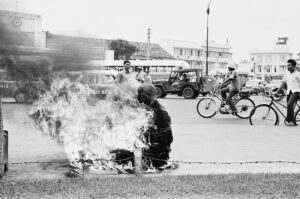
As such, the Kurdish movement has also condemned some instances of seemingly-political suicide. After the Kurdish leader Abdullah Öcalan was captured, and numerous Kurds self-immolated in protest, the Kurdish movement have been forced to issue multiple rebukes. The Kurdish leader “has clearly stated in the past that he deeply values such manifestation of willpower, but he does not approve of such actions”, according to Kurdish political representatives. These foolhardy actions might be understandable, borne out of frustration or rage – but if so, they cannot ultimately prove transformative. To the Kurdish movement, true martyrdom comes unlooked-for, with no straightforward hope of personal elevation or political impact. If it is a blessing, an elevation, it can only ever be bestowed and not taken.
Conversely, therefore, the Kurdish movement celebrates the example of its members like those who set themselves alight in Diyarbakır prison, becoming icons of resistance in extremis. These deaths must come at a point of desperation, serving as the ultimate act of self-reclamation for those targeted by state violence, placing it forever beyond the reach of state violence. Indeed, we have already witnessed the first instances of political self-immolation in response to the climate crisis, joining the Tunisian fruit merchant Mohamed Bouazizi whose self-immolation sparked the Arab Spring, joining the select desperate ranks of monks, refugees and activists who have put themselves to the torch in a final, silent shriek of protest. Very often, it seems from the news reports, those who set themselves alight for political reasons do not cry aloud at all.
As the poet George Starbuck has suggested in a beautiful, sad poem memorialising the famous suicide by self-immolation of Norman Morrison in protest against the Vietnam war, these political suicides offer “nothing to quote, nothing to put in quotes”. Bouazizi left no note, and yet his despairing, personal act catalysed near-global convulsions. There is a grim, terrible beauty in the fact he never intended nor expected to provoke a political response, was seeking only personal retribution. Here, the act of self-immolation simply stands, in itself, as a final shriek of protest, when all else is lost. It does not seek glory or a cheap transfer to paradise. It stands only for itself, as its own “language”, speaking to us only in the quiet of our own hearts.
Though he will be lionized in certain quarters, remembered as a martyr in Palestine and elsewhere, Bushnell’s action should not be understood merely as an attempt to change the course of the war. Its significance is more profound, more stark, more simple than that. Starbuck closes his poem with an admonition to his contemporary American authorities: “It is a strange sect… under advice to try / the whole of a thought in silence, and to oneself.” The true meaning of Bushnell’s protest lies beyond words, beyond reason, in pure desperation. Through the fact of its voicelessness, the protest speaks.
*Matt Broomfield is a freelance journalist, poet and activist. He writes for VICE, Medya News, the New Statesman and the New Arab; his prose has been published by The Mays, Anti-Heroin Chic and Plenitude; and his poetry by the National Poetry Society, the Independent, and Bare Fiction. His work was displayed across London by Poetry on the Underground, and he is a Foyle Young Poet of the Year.


