

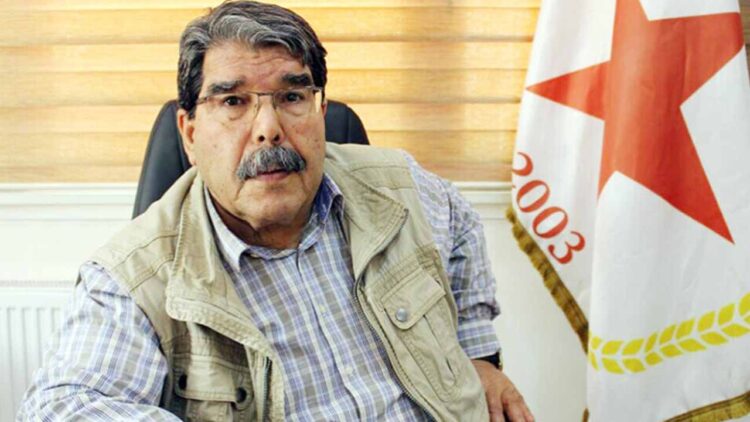
While Turkey was once a pivotal player on the global stage, its importance has waned in the post-Soviet era, primarily due to its unresolved Kurdish issue, argues Salih Muslim*, a key Syrian Kurdish political figure and former co-chair of the Democratic Union Party (PYD)*, in an interview with ANF on Thursday.
Muslim attributed this decline to several factors, with the unresolved Kurdish issue being a major contributor. He emphasised that Turkey’s geographical position, once a critical asset during the Cold War due to its proximity to socialist states and its large territory, has lost much of its value in the post-Soviet era. This loss is further exacerbated by advances in technology, such as the development of satellites and the internet, which have altered geopolitical dynamics.
Muslim also highlighted that Turkey’s internal instability, particularly the lack of resolution to the Kurdish question, has been a significant hindrance to its geostrategic influence. He mentioned the efforts of former President Turgut Özal in the 1990s to create stability and promote trade, which were undermined by the ongoing Kurdish conflict. According to Muslim, this unresolved issue has led to Turkey’s gradual decline in geostrategic significance and influence in regional politics.
Erdoğan utilises Turkey’s geostrategic position for personal interests
Erdoğan exploits Turkey’s geostrategic location for his own interests, drawing attention from various countries. How do you assess this in the current phase?
Turkey holds a geographically important position. Its geostrategic location was particularly crucial at NATO’s founding in 1952. The Turkish state then maintained relationships with both Asia and Europe. Its large territory and opposition to Soviet Russia and many socialist countries heightened its significance for NATO. NATO established bases in Turkey, such as the Incirlik Air Base, thus securing Turkey’s position in the alliance. Numerous agreements were signed, benefiting Turkey greatly. However, following the Soviet Union’s collapse, Turkey largely lost its geostrategic importance. Technological advancements, the rise of satellites, the internet, and air travel development have further deteriorated Turkey’s situation. During the Cold War, Turkey’s importance was amplified by NATO bases within its borders and its role as a barrier against real socialist states. The dissolution of the Soviet Union and technological evolution largely erased Turkey’s key geostrategic position.
Capital comes into play
When global capital seeks development in a location, it desires stability. Post-1990, efforts were made to ensure stability in Turkey. Then-President Turgut Özal initiated measures to guarantee stability and boost trade in Turkey. However, resolving the Kurdish issue was necessary for this. Attempts to resolve the Kurdish question within Turkey were unsuccessful, leading to a gradual loss of Turkey’s geostrategic significance. Had Turkey achieved internal stability, numerous developments, including improved energy supply and trade, could have been possible. However, Turkey failed in this regard, primarily due to its refusal to address the Kurdish issue, Turkey’s most significant problem. It was incapable of providing stability or addressing the fundamental problems needing resolution. Therefore, Turkey’s importance continues to diminish day by day.
Erdoğan’s old mentality and Turkey’s ongoing decline
Erdoğan still thinks with an old mentality, believing Turkey can maintain its former importance and thus impose his will on everyone. He aims to enforce his neo-Ottoman dreams and desired policy in the Middle East. However, each passing day sees Turkey losing both its geostrategic position and global capital. With this mentality, Turkey can only lose. Erdoğan’s chauvinistic and neo-Ottoman dreams are harming not just the Turkish state but also its entire population, particularly the Kurds. Unfortunately, this mentality remains a significant problem for everyone. Due to this policy, even hegemonic powers are increasingly distancing themselves from Turkey. As long as Turkey persists with this policy, it will continue to lose, as such a policy is no longer acceptable.
The Autonomous Region of North and East Syria is also strategically located. Many hegemonic and regional powers have plans here. How do you think the ongoing war between Israel and Hamas will affect Syria and Rojava? To what extent does it influence Erdoğan’s current policy?
Many analyses suggest that the Israeli-Palestinian war results from the failure of capitalist powers to reach an agreement. They intended to reopen the old Silk Road through Turkey and Iran to Europe. Both Iran and Turkey desired this. However, at the G20 summit in India, they sought to change this route to pass through the Gulf states, Saudi Arabia, the Mediterranean, and then to Greece, excluding both Turkey and Iran. It is now said that Turkey initiated this war to prevent the realisation of this project. Many assessments claim Turkey ordered Hamas to attack, thereby exacerbating chaos in the Middle East, and implicating Turkey in the war.
There is a high likelihood that the conflict will escalate. In such a scenario, Lebanon, Jordan, and Syria could be drawn into the war, creating a state of disarray. It is uncertain who will stand where. However, Syria’s position is crucial. The first project I mentioned excluded Syria. The previously planned gas pipeline project in North and East Syria was not realized, despite Qatar and other countries’ interest. If their alternative project also fails, they will revert to North and East Syria. But it is unclear to what extent they can agree on this project. Moreover, they have overlooked one factor: the Kurdish people. An administration has been established in North and East Syria, and this administration forms a system. Today, the West and all hegemonic powers can accept this system, which will bring a solution. However, regional states such as Turkey, Syria, and Iran do not accept it. Hence, we are still at war. Our struggle has not lost its significance. We hope it will bring stability both for us and our neighbourhood. However, I believe the Gaza issue will change many things. There is a possibility that the war will expand and spread to other states. Lebanon, Egypt, and Jordan might get involved. It is unclear where this war will end. But all balances in the Middle East will change.
Erdoğan seeks to declare himself Caliph
Many countries in the world lead the capitalist modern era, with Turkey playing this role in the Middle East. To what extent, in your opinion, does Turkey fulfil this role?
From 2002 to 2013, Erdoğan accepted the projects of hegemonic powers. However, Eurasia then came into play. Eurasia intends to unite Turkic states in a grand Ottoman Empire, similar to the unification of all Arab states in the Arab League. However, these projects have failed. In 2013, the deep state completely took over Erdoğan, leading to a total shift in his policy. All projects were centred around Erdoğan. He began to act according to his own visions, utilising Turkey’s geostrategic location. On one hand, Erdoğan did not detach from NATO, and on the other, he developed relations with Russia. He did all this to maintain his power. He also used his international relations for domestic politics. His domestic policy? The annihilation of Kurds. He refuses to resolve the Kurdish issue, aiming for total control and the establishment of a Muslim Brotherhood state. He has completely transformed. However, capitalist forces and many other circles desire stability and democracy in Turkey. But Erdoğan is neither prepared for democracy nor for a resolution. He has dedicated everything to his own power. Erdoğan aims to declare himself Caliph. Making Erdoğan a Caliph or Sultan aligns with the deep state’s policy. This policy has driven Turkey to bankruptcy. Economically, Turkey collapses day by day. Its currency holds no value. It is bankrupt diplomatically and politically. Despite Erdoğan’s attempts to mediate in the Gaza war, he has become increasingly isolated. He has sacrificed Turkey’s geostrategic position and international capital for his personal power. He continues to lose, and it is unclear how long this will last. Turkey drifts further from democracy daily, even ignoring its constitution. Journalists and politicians are arrested every day. There is no justice system left; rulings of the European Court of Human Rights are disregarded. All this, however, paves the way for Turkey’s collapse. It is uncertain how long this will last, but this policy will eventually lead to Turkey’s downfall.
Turkey’s loss due to unresolved Kurdish issue
Capitalist modernity has no fixed place. It uses countries like England, France, and the USA for its purposes, but it is everywhere. One of the states it used was Turkey. The Greater Middle East Project, especially developed after the 1990s, was a project of capitalist modernity. It aimed to shape the Middle East according to its standards, relying on Turkey. Turkey was both a regional state and a NATO member, with military forces ready for deployment. In this sense, Turkey assumed the role of an important actor. However, Turkey’s role was not that of a politician but of a recipient and implementer of instructions. Erdoğan even openly declared, “I am the president of this project.”
However, the Turkish state did not abandon its own pathologies. The Kurdish question was at the forefront. The owners of this project wanted the Kurdish question resolved within Turkey, which the Turkish state did not accept. Steps like the Oslo talks were initiated; there were discussions with the Kurdish representative on Imrali. Abdullah Öcalan genuinely wanted to solve this problem. However, the Turkish state changed its policy and destroyed all solutions. Nevertheless, the forces of global capitalist modernity have not abandoned their project. They gradually aim to disengage from Turkey. Since 1952, NATO has signed many agreements with Turkey. It counted on Turkey for the Greater Middle East Project. Of course, Turkey also greatly benefited from this situation. But today, they are trying to get rid of Turkey, as the Turkish state is also an annoyance for them. It is an obstacle to their projects. When they founded the great Middle East project together, there were mutual promises. At that time, the Turkish state did not want the Kurds to participate. How can 50 million Kurds in the Middle East be excluded? They have proven their existence through their struggle and have thus become part of this project. And Erdoğan still claims there are no Kurds. With this false policy, he has set back both Turkey and the entire region. He has also hindered the progress of the Greater Middle East Project created by the hegemonic powers, the forces of capitalist modernity. Until today, he has only created obstacles. For this reason, it can no longer be said that the Turkish state is part of the project created by these powers. On the contrary, it has now become a significant problem for them.
*Democratic Union Party (PYD)
The PYD is a Kurdish political party established in 2003 in Northern Syria, also known as Rojava. It is known for its advocacy of democratic confederalism, a form of direct democracy with an emphasis on local governance, gender equality and ecological sustainability. The PYD’s ideology is influenced by the ideas of Abdullah Öcalan, the founding leader of the Kurdistan Workers’ Party (PKK).
The PYD has been a key player in the Syrian Civil War, particularly in the fight against ISIS. The party’s armed wing, the People’s Protection Units (YPG), along with the Women’s Protection Units (YPJ), have been instrumental in combating ISIS in Syria. These forces have been part of the Syrian Democratic Forces (SDF), a coalition of Kurdish, Arab and Assyrian/Syriac militias. The SDF, with the support of the United States and the international coalition, has played a significant role in recapturing territories, including the de facto ISIS capital of Raqqa.
*Salih Muslim
Salih Muslim is a prominent Kurdish politician from Syria. He was the co-chair of the PYD from 2010 to 2017 and remains an influential figure in Kurdish politics. Muslim is known for his advocacy of the Kurdish cause in Syria and has been a vocal opponent of the Turkish government’s policies towards the Kurds. His role has been central in negotiating alliances and managing the delicate balance of regional and international interests in the context of the Syrian conflict.


