

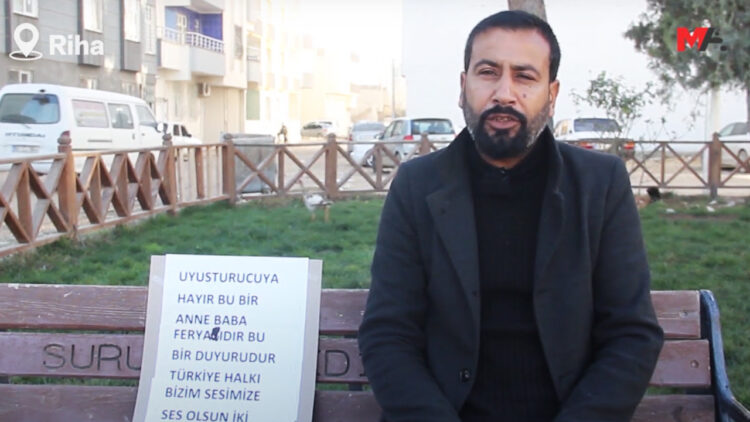
Hüseyin Yılmazoğlu, a father to sons who both suffer substance addiction, questioned how drugs enter the town of Suruç (Pirsûs) in the Kurdish-majority southeastern Urfa (Riha) province of Turkey, despite heavy surveillance and multiple security force checkpoints.
Yılmazoğlu has been struggling for six years to rescue his two sons from addiction in a region where drug use has alarmingly increased, affecting many families.
In Urfa, a city with over 2.3 million inhabitants, the age of drug users has dropped to as low as 11 years. The city, however, is inadequately equipped to tackle this issue, with only a 30-bed Addiction Treatment Centre and a 15-bed Child Adolescent Alcohol Substance Treatment Centre. The increasing drug-related deaths and the apparent inaction against addicts and dealers contradict the Turkish Interior Ministry’s claims of an effective anti-drug campaign.
Suruç, strategically significant for the Kurdish liberation movement and located near the border of North and East Syria, faces a unique challenge. The ease of obtaining drugs in public spaces like parks, schools and side streets, despite the heavy presence of military and police forces, surveillance cameras, and checkpoints, has been described as more straightforward than sourcing basic necessities. This situation challenges the government’s assertions of a robust fight against drugs.
Emrullah Acar from Mezopotamya Agency discussed the town’s situation on Tuesday with Yılmazoğlu, whose elder son, B. Yılmazoğlu (20), started using drugs at 14, and his younger son, D. Yılmazoğlu (18), six years ago. Despite his efforts and public appeals for awareness, local state officials have not granted him an audience. Yılmazoğlu’s repeated attempts to meet with the Suruç Police Chief and District Governor have been unavailing. He claims almost every family in Suruç has a member struggling with addiction and alleges threats from law enforcement for raising his voice against drug abuse.
The Green Left Party (predecessor of pro-Kurdish Peoples’ Equality and Democracy Party, or DEM Party) Youth Council initiated a campaign in August 2023 titled ‘Glorious Resistance Against Special War’, highlighting drug trafficking, gang formation and prostitution as tools used by state forces to undermine social opposition, particularly in Kurdish regions. This allegation parallels the policy of using drugs as a means of social control, a tactic previously seen in the 1990s in Kurdish-majority areas.
The Susurluk scandal, which emerged from a traffic accident in Balıkesir’s Susurluk district in 1996, revealed a web of connections between the state, mafia and political figures, hidden under the guise of “fighting terrorism“, casting a long shadow over Turkish politics. This scandal illustrated the entanglement of state forces in various illegal activities, including drug trafficking, in the 1990s, raising questions about state involvement in such practices.


