

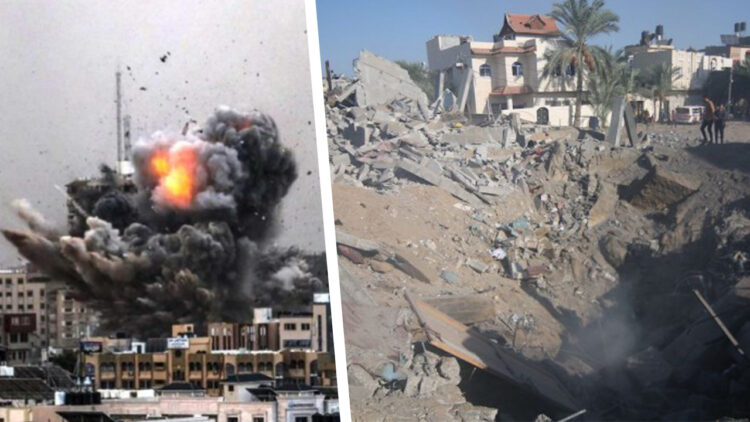
The escalating conflict, which has turned into a full-scale war between Israel and the Palestinian militant group Hamas, has claimed more than 4,000 lives in Israel and Gaza and displaced more than a million people. Both Hamas and Israel have rejected calls for a ceasefire as Israel prepares for a full-scale ground operation, with the United Nations (UN) describing the situation in the Middle East as ‘‘on the verge of the abyss”.
Hamas launched attacks against Israel on 7 October, known as the ‘Aqsa Storm’, leading to relentless Israeli air strikes on the besieged Gaza Strip. With water and food supplies in Gaza running critically low, the Palestinian branch of the World Health Organisation (WHO) reported that at least four hospitals in Gaza are unable to provide medical services due to the bombardment.
The organisation also revealed that Israel has issued evacuation warnings for a further 21 hospitals in the blockaded territory. The United Nations (UN) has expressed deep concern that thousands of lives in Gaza are at risk due to the disruption of electricity supply and the depletion of fuel reserves at the enclave’s only power plant.
United Nations Relief and Works Agency for Palestine Refugees in the Near East (UNRWA) Director Juliette Touma said that the one million displaced Palestinians were moving to different parts of the Gaza Strip. She suggested that the actual number of displaced people is likely to be higher as people continue to leave their homes.
The Gaza Ministry of Health reported that Israeli air strikes have killed at least 2,750 Palestinians and wounded another 9,700 since the start of the conflict. The Palestinian Journalists’ Syndicate reported that 11 Palestinian journalists have been killed by Israeli air strikes in Gaza.
These figures indicate that the number of Palestinians killed in the latest conflict has surpassed the death toll from the 2014 Gaza war, which lasted 50 days and resulted in the deaths of 2,250 Palestinians, 66 Israeli soldiers and five civilians.
“Gaza is being strangled and it seems that the world right now has lost its humanity,” lamented UNRWA Commissioner-General Philippe Lazzarini.
Meanwhile, Israeli Prime Minister Benjamin Netanyahu announced that Israel will continue to blockade Gaza, preventing the supply of water, food, electricity and fuel, until all hostages are released. The Israeli military is also preparing for a major ground operation in Gaza. During a visit to frontline soldiers, Prime Minister Netanyahu asked, “Are you ready for the next one? More is coming.”
German Foreign Minister Annalena Baerbock stressed that Qatar, Turkey, and other countries that have open channels of communication with Hamas, must act rapidly to mediate.
Palestinian President Mahmoud Abbas condemned Hamas and its actions, stressing that the only legitimate representative of the Palestinian people is the Palestine Liberation Organisation (PLO). He condemned the violence and called for the immediate cessation of Israeli aggression, the protection of the people, the opening of humanitarian corridors and the supply of medical supplies, water, electricity and fuel.
Abbas rejected the expulsion of the people of Gaza, warning that it would constitute a second “Nakba” (catastrophe). He urged the release of all prisoners and detainees on both sides and called for the rejection of violence in favour of peaceful resistance and political action to achieve a political solution to end the occupation. Abbas underlined the policies, programmes and decisions of the PLO as the only legitimate representation of the Palestinian people, stressing the absence of any other entity with political relevance.


