

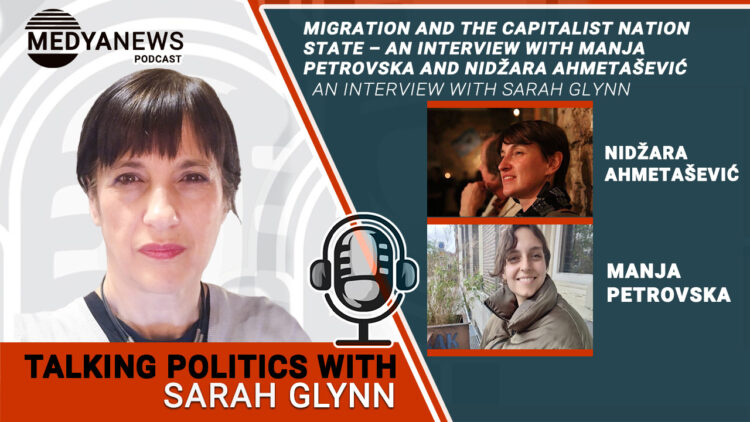
Sarah Glynn
With tightening immigration rules leading to ever more catastrophes, political rhetoric hardening, and more and more of the world being made uninhabitable, Sarah Glynn talks politics with two researchers who’ve written critically about migration control, Manja Petrovska and Nidžara Ahmetašević. Manja is a researcher at the University of Amsterdam, and Eur Asian Border Lab, where she focuses on how the European Union has outsourced its border controls. Nidžara is a journalist from Sarajevo, who writes about human rights, migration, war crimes and the role of the media.
Below are highlights of the interview, lightly edited for clarity:
SG: Migration is a subject that we most often hear about through the filter of politicians’ myths, so can you give an overview of the nature of migration today?
NA: I love this formulation that you use – that we often hear about migration through politicians’ myths… What politicians do with these myths is to try to present migration as something that is related to some criminal activity, to terrorism, even something that presents danger – something that we should be afraid of and something that is almost a new phenomenon. However, all of us are well aware that migration is something that exists as long as we exist in this world, that whole civilizations are based on migrations, and that it’s a natural process that brings changes, which are more often a positive for all of us than negative.
SG: Moving on from that to the specifically European situation: Manja, can you outline how what has been called Fortress Europe has developed and continues to develop its border controls?
MP: Fortress Europe is basically something that has been used to describe the EU’s preoccupation with securing its external borders. And, while this is often seen as a new policy that came into effect with the so-called long summer of migration in 2015, it has been something that has been being developed at the very core of the formation of the European Union… since the formation of the Schengen agreement in 1985. The way this was sold to the public was, in order for Europe to be safe and for freedom of movement to be allowed within the internal Schengen borders, we must protect ourselves from the external threat… Now, it’s not just about protecting the EU’s external borders. EU externalisation policies are being introduced in other places, such as North Africa, the Middle East, Central Asia and even Latin America… The European Union is essentially controlling the borders of a lot of the world that we know…
EU border externalisation denotes the strategic outsourcing of border control and migration management to non EU countries… In this process, so-called EU partner countries, such as Turkey, receive financial assistance, training, and technical support to strengthen their ability to control migration in the interests, predominantly, of EU markets. So the EU-Turkey deal, which began to take shape in 2015 and was then expanded in 2016, was a $6 billion development assistance fund offered to Turkey to control or withhold people from entering Greece and following down the Balkan route…
However, a lot of this funding is used for border control – bolstering police forces, implementing data surveillance systems. And when that is in the hands of a leader like Erdoğan, you can assume that human rights violations are part of that deal, also.
SG: The basis of much immigration control is distinguishing between those people who are under threat and in need of asylum, and so-called economic migrants; but can we actually make such a distinction, is such a distinction possible?
NA: I don’t believe it is – or it should be… That’s a very problematic distinction between people. In this way, basic rights – and one of these is freedom of movement – are taken away from people… And somebody puts themselves in a position to pick and choose who can stay and who cannot… Also very important for me… is freedom to dream, to dream about a better life… Allowing only some people that some administrative officer believes are in danger the freedom to live a normal life is highly problematic.
SG: We can see that people are taking huge risks, and every now and then an especially appalling disaster makes headlines. I think most people really feel sympathy for the victims of these disasters, but those same people don’t want to see their country opened up to unlimited migration. They are fearful of falling wages, because if you have an increased reserve army of labour in a capitalist system that’s what happens at the bottom. They’re concerned about competition for limited housing. And they’re concerned about sudden cultural change. So what do you say to those people – to the people on the street who are concerned in their communities about migration?
NA: I’m not sure that people do really have a chance to express their will. And – going back to your first question when you mentioned political myths – unfortunately, I think that many people easily fall for these political myths and start thinking in that way… If we find a way to explain to people that these mechanisms that are used today against migrants, tomorrow will be used against them, then people will maybe start thinking about the other side of this problem, which is the state taking over the will of the people and diminishing democracy, diminishing our basic rights.
If you just hear my surname of Ahmetašević – there are two migrants living in my surname: somebody from the Ottoman Empire, and somebody who came here with Slavic origin. All of us have this… We just have to remind ourselves that, basically, that’s what we are. We are migrants, and we build the world together.
MP: By illegalising migration, what that does is create a super-exploitable workforce, within the European Union, of people that have no rights to the state, essentially, so work in the the black economy, fear deportation, have no access to public support… And EU countries open up legal routes – labour migration – which allows those countries to cherrypick people based on market needs, as opposed to people that actually need to migrate to be safe from the effects of global capitalism.
NA: If you look around, the biggest number of migrants are in poor countries, and I’m not sure that people in these countries are complaining and finding that as problematic – or the media – as in very rich countries of northern Europe… When we talk about criminalisation of migration, when we talk about fortification of borders, we are talking about the West. And the problem is not people who are coming from the south, but is rather distribution of wealth. And people in countries that are not as wealthy as some northern European countries, they do not fight migrations – like in Bosnia. I’m coming from Bosnia and Herzegovina. This is quite a poor country. Many citizens here are very welcoming towards migrants because we are migrants at the same time, and we also look for a better life in some other countries, so we understand this as a normal process…
SG: I want to go back to a point that Manja was making, because I think it relates to my question about the increased reserve army of labour – which, if you have more people you will have, and which makes bargaining more difficult as a worker – but you’re saying that by having immigration controls, then you’ve actually got people who are competing even more more cheaply, because they can be super-exploited because they’re illegal. So capitalism wins, whatever. The problem is the capitalist system is just going to exploit people one way or the other.
MP: I think that’s a point that’s often missed: that migration management is literally just a euphamism for Western countries to exploit a global workforce of people in their own interests, and manage their movement in their own interests, as opposed to the natural rhythm, as Nidžara was mentioning, of populations migrating since the dawn of time.
SG: But perhaps the bigger forced migrations now are also themselves a result of capitalism, which is making so much of the world unlivable both through exploitation and through war, and increasingly by environmental destruction.
MP: The funny thing is, if you look at the border industry and the arms industry – the arms industry which causes a huge amount of people to be forcibly displaced from their homes as refugees – that same industry then profits off the border industry, which controls their movement or attempts to prohibit them going to the West. Since the 1990s, many big arms corporations have actually dedicated a new section for border control. So you can see the contradictions within these processes: the companies that are causing people to flee are then profiting from the states that are trying to stop those people from entering their own territories.
SG: So, for them, not a contradiction, a win-win.
MP: Exactly. And a lot of EU policies are being influenced by arms companies. There’s been quite a lot of research on this. A lot of lobbying happens… EU policies are driven by market interests, but also by those companies that profit from the ever-increasing expansion of border control, which includes arms companies, but also smugglers – a very small amount – and NGOs.
NA: The only solution that I see for this problem at this moment is to abolish the borders and the whole border regime that brings profit – as Manja said – only to those who are the richest among us, and to those who are taking the power from the people.
MP: We forget that all forms of racism and prejudice have been bureaucratised in the form of a passport that has created a border apartheid regime where some people are free to travel wherever they want while others are forced to bear the brunt of the impacts of global capitalism, exploitation, war and poverty. People need to understand that the passport is really the truest form of hierarchy in our system at the moment. Based on this piece of documentation, your rights are determined. Either you have rights, you have lots of rights, or you have none at all. I think that’s something that people don’t see.
I agree with Nidžara. We need a world without states and borders, and I think the more people understand the issues that exist within their own lives and within the world more generally, they would actually support such things, which the Kurdish Resistance Movement is doing a really great job at teaching them about.


